Recovery yield and substitution ratio: product per kg of waste
The two quiet multipliers of a recovery credit: yield, which describes process loss, and the substitution ratio, which describes quality. Catalogue yields by material, the moisture correction and downcycling.
By clca Editorial TeamLast updated
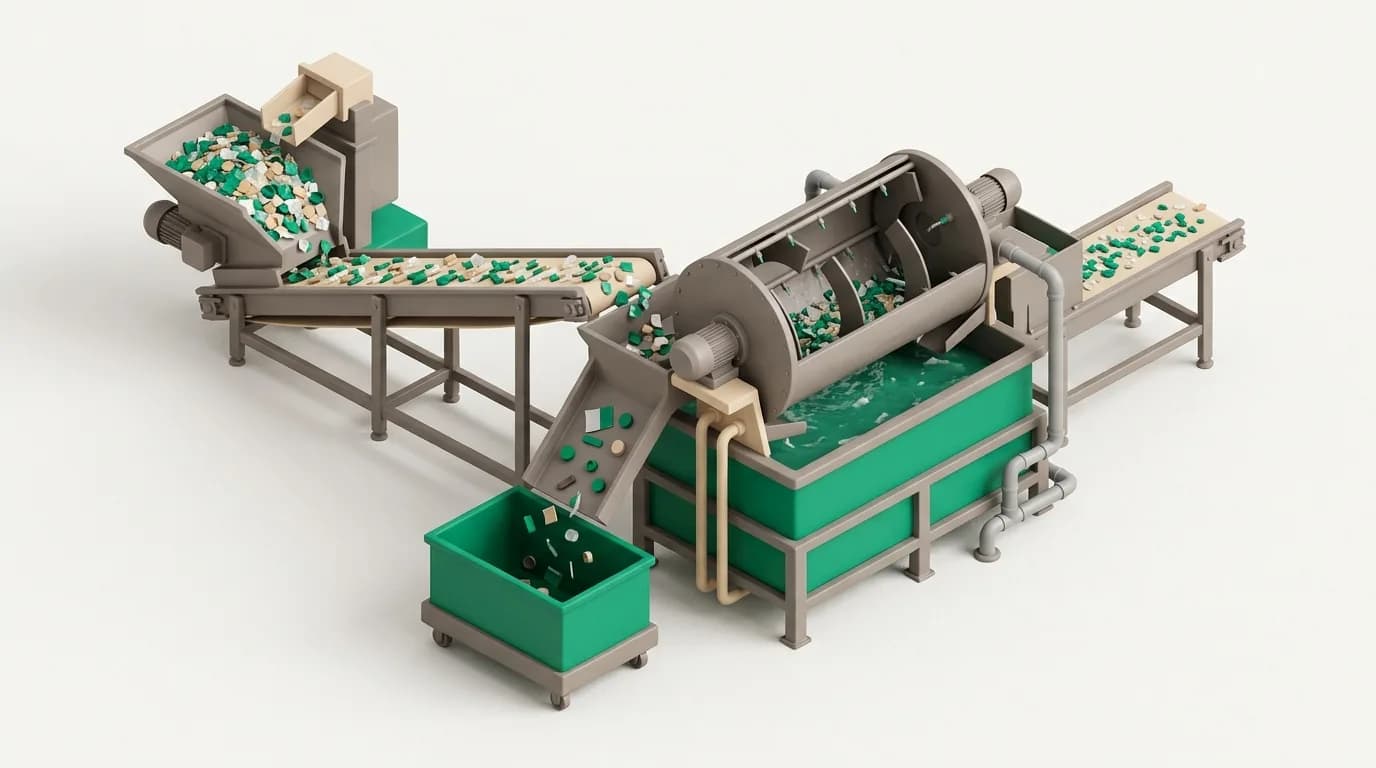
Recovery yield states how many kilograms of secondary product are obtained from 1 kilogram of collected waste; the substitution ratio states how many kilograms of virgin product that secondary product replaces. Together they form the mass side of the avoided-emission formula: dry mass × yield × substitution ratio is the “effective product mass” to which the factor gap is applied. These two multipliers are the least conspicuous but most uncertain part of the calculation. Yield is an engineering fact that can be read from a database; the substitution ratio is a market judgement that has to be defended. This article defines the two separately, gives catalogue values by material and explains the mistakes that push yield above 1.
Yield: the measure of process loss
Yield is the inverse of the mass lost in the recovery process. Pieces rejected on the sorting line, contamination removed in washing, slag and dross formed in melting, short fibres screened out of paper pulp — all of them make up the difference between input and output. In ecoinvent that difference is read directly from the input table of the secondary product activity: if the activity demands a given number of kg of waste input per kg of product, yield is its inverse. For PET, the recycled bottle-grade granulate activity requires 1.215 kg of sorted waste PET per kg of product; yield is therefore 1/1.215 = 0.823. The value varies with technology and input quality, but because the database represents a specific mix of plants it is defensible as a starting point.
The mass basis of the yield definition must be stated explicitly. The value of 0.80 for wood is on a dry-mass basis; confused with wet mass, the same number means something entirely different. In paper, pulp yield falls with the number of times the recovered fibre has been through the loop; the catalogue value represents the first cycle. For glass, yield does not describe the share of cullet entering the furnace but the conversion rate from sorted cullet to glass product; that distinction matters in the section on marginal derivation.
Catalogue yields by material
The values below are yields derived from ecoinvent 3.12 cut-off datasets and the input tables of the corresponding activities, as used in a curated catalogue. Each is tied to a specific primary–secondary activity pair; if the pair changes, the yield must be re-read.
- PET bottles (sorted) → recycled bottle-grade granulate: 0.823 — direct reading, high confidence
- Mixed paper → testliner (containerboard from recovered fibre): 0.941 — direct reading, high confidence
- Packaging glass (cullet) → white packaging glass: 0.926 — marginal derivation, cullet share 0.605, high confidence
- Steel scrap → electric arc furnace steel: 0.884 — direct reading plus grid correction, medium confidence
- Aluminium scrap (post-consumer) → remelted aluminium: 0.991 — direct reading, high confidence
- Post-consumer wood → wood chips: 0.800 (dry mass) — direct reading, medium confidence
- Mixed textiles → recycled polyester fibre pellet: 0.700 — proxy dataset, low confidence
The confidence grade matters as much as the yield itself. “Direct reading” means ecoinvent contains both the virgin and the recycled activity of the same product and the yield is taken from the input table. “Marginal derivation”, as for glass, means that with no separate secondary product activity the value is derived from the difference between two activities at different cullet shares. “Proxy” means the real route does not exist in the database and the closest analogue is used; for textiles, recycled polyester pellet is a proxy for mechanical fibre recovery, and the report must carry that caveat.
Dry mass and the moisture correction
Yield is applied to dry mass; the weighbridge, however, weighs wet mass. The gap ranges from negligible to decisive depending on the stream. In metal and glass, moisture is a few per cent and contamination usually matters more. In paper and board, 8–15 per cent moisture is typical and bales left out in the rain exceed 20 per cent. Organic waste carries 60–80 per cent moisture, and any figure given without a dry-mass calculation is meaningless. The correction is simple: dry mass = wet mass × (1 − moisture fraction). Ten tonnes of mixed paper at 12 per cent moisture give 8.8 tonnes of dry mass; at a yield of 0.941 that yields 8.28 tonnes of testliner. Where moisture is not measured, a conservative (high) assumption is chosen for the stream and written into the report with its justification.
Substitution ratio: what does the secondary product really replace?
The substitution ratio describes the quality relationship between the recovered material and the virgin product it displaces on the market. For bottle-to-bottle PET, scrap remelted into the same aluminium alloy and cullet made into packaging glass, 1.0 is defensible: the secondary product meets the same specification and enters the same application. The ratio falls below 1 for two reasons. The first is technical downcycling — the chain length of a recycled polymer shortens, its mechanical properties decline, and it goes to a less demanding application. The second is market substitution — if a park bench made from mixed plastics replaces timber, the correct primary factor is timber rather than virgin plastic, and both the definition of the ratio and the factor pair change.
A substitution ratio above 1 is the exception and is accepted only with a documented justification: the secondary product performing the same function at a thinner section, for example, or the virgin product coming from a distant market with the transport that implies. An unjustified 1.2 is the first line a verifier will question. Because this is the input with the most concentrated uncertainty, sensitivity analysis is run by moving the ratio between 0.8 and 1.0 and the credit is reported as a range.
Why yield cannot exceed 1 — and what has happened if it does
Conservation of mass is the first audit rule of a recovery calculation: one kilogram of waste cannot produce more than one kilogram of product. If yield appears above 1 there are three explanations. The moisture correction has been skipped and a dry-product factor applied to wet waste mass. Units have been mixed — input in tonnes, output in kilograms, or one side by volume. Or substitution ratio has been confused with yield and two multipliers squeezed into one number. A well-built calculation tool warns for yield > 1 and errors above a clear threshold (1.05, say); small overshoots can come from rounding and measurement uncertainty, large ones are definition errors.
Uncertainty and reporting
Yield and substitution ratio carry most of the uncertainty budget of a recovery credit. Uncertainty in yield is technological and narrow: for the same material the spread between plants is usually 5–10 per cent. Uncertainty in the substitution ratio is structural and wide: the difference between 0.8 and 1.0 is directly a 20 per cent difference in credit. The report lists both inputs explicitly per stream, states their source (ecoinvent activity, catalogue version, plant measurement) and gives a range alongside the base scenario. A report that hides yield and substitution also hides where the credit comes from.
Frequently asked questions
- What is recovery yield?
- It is the number of kg of secondary product obtained from 1 kg of collected waste, reflecting the mass lost in sorting, washing, melting and screening. It is read from the input table of the secondary product activity in ecoinvent — for PET, 1 kg of granulate requires 1.215 kg of waste, so yield is 0.823.
- What is the substitution ratio and why can it be below 1?
- It is the number of kg of virgin product that 1 kg of secondary product replaces. If the recycled material loses quality (downcycling) or goes to a less demanding application the ratio falls below 1; for equivalent quality such as bottle-to-bottle PET it is taken as 1.0.
- Is yield applied to wet mass or dry mass?
- To dry mass. The weighbridge gives wet mass; dry mass is found by deducting the moisture fraction (dry = wet × (1 − moisture)). Moisture of 8–15 per cent is typical for paper and 60–80 per cent for organic waste; skipping the correction inflates the credit by the same proportion.
- What should be done if yield comes out above 1?
- Stop the calculation and check the definition. Almost always the moisture correction has been skipped, units have been mixed, or the substitution ratio has been merged into the yield. By conservation of mass, 1 kg of waste cannot give more than 1 kg of product; a value above 1.05 is a definition error.
- Why is the yield for glass found by marginal derivation?
- ecoinvent has no separate “recycled glass” activity produced from cullet; glass production is defined at different cullet shares. The difference between production without and with cullet is therefore divided by the cullet share (0.605) to convert it into an impact per kilogram of cullet.
Tags
- recovery
- recycling credit
- recovery yield
- substitution ratio
- downcycling
- waste management
- circular economy
- dry mass
Related reading
All articles in Data & Methods- Data & Methods
Energy recovery or material recycling? Comparing the credits
The same tonne of plastic displaces electricity if burned and granulate if recycled — but the two credits are not the same size and cannot both be granted to one stream. The waste hierarchy, EN 15804 Table 13 and the formulae.
11 min read - Data & Methods
Recovery calculation: how to quantify avoided CO₂e and energy
A recovery calculation measures how much greenhouse gas and primary energy is avoided compared with the scenario in which a waste stream is not recovered. The formula, the four inputs and a worked 100-tonne PET example.
11 min read - Data & Methods
Recovery of organic waste: compost, biogas and open dumping
Organic waste substitutes no product; the credit comes entirely from avoided methane. Open dumping, landfill, composting and biogas compared on ecoinvent 3.12 data.
12 min read - Data & Methods
Recovery credits by material: from PET to aluminium
A tonne of recovered aluminium and a tonne of paper do not earn the same credit. The primary and secondary route, the order of magnitude of the credit and the specific trap for each of six materials.
12 min read