Recovery of organic waste: compost, biogas and open dumping
Organic waste substitutes no product; the credit comes entirely from avoided methane. Open dumping, landfill, composting and biogas compared on ecoinvent 3.12 data.
By clca Editorial TeamLast updated
The recovery credit of organic waste is the difference between the emissions of the route the waste actually takes and the disposal emissions that would have occurred had it not been recovered. Unlike PET or aluminium, no product is substituted here: a tonne of kitchen waste sent to a composting plant does not replace a virgin material; what is avoided is the methane that would form in an open dump or a landfill. Organic waste streams are therefore 'treatment-type' streams — the yield is taken as 1.0 and the credit comes entirely from the factor difference between two disposal routes. On ecoinvent 3.12 data that difference between open dumping and industrial composting is roughly 0.47 kg CO₂e per kilogram; at large tonnages it becomes one of the most visible lines in the balance.
Why a 'treatment-type' stream: nothing is substituted
For material streams the credit formula has four factors: dry mass, yield, substitution ratio and the primary–secondary factor difference. For organic waste two of these are fixed. The yield is 1.0 because there is no measured 'product' output — a tonne of waste is a tonne of treated waste. The substitution ratio is also 1.0 because there is no production route being replaced. What remains is the mass and the factor difference between two routes: the primary factor is the emission of the counterfactual disposal (where the waste would have gone had it not been recovered), the secondary factor is that of the actual treatment route. This simplification makes the arithmetic easy but hides a trap: the whole credit depends on the choice of counterfactual. Against an open-dump assumption the composting credit is large; against a modern landfill with gas collection the credit of the very same composting plant falls by more than half.
The substitution of mineral fertiliser by compost or digestate used as a soil improver is a separate credit and does not enter the main formula. It is added only when the nutrient content (N, P, K) has been measured, the quantity of fertiliser replaced has been justified and it has been shown that the same benefit is not counted elsewhere. In corporate balances this second credit is usually left out as a matter of prudence and the report is described as a 'lower bound'.
The counterfactual: methane in open dumps and landfills
When organic waste decomposes without oxygen, part of its carbon turns into methane. In IPCC AR6 biogenic methane has a GWP-100 of roughly 27; every kilogram of methane formed in a landfill produces a warming effect equivalent to twenty-seven kilograms of CO₂. In an open dump that methane goes straight to the atmosphere, which is why the ecoinvent 3.12 dataset 'treatment of biowaste, open dump | RoW' carries a factor as high as 0.528 kg CO₂e per kilogram. In landfills with gas collection part of the methane is captured and flared or converted to electricity; the factor falls well below open dumping but stays far above composting, because collection efficiency is never one hundred per cent at any site and gas continues to escape after the site is closed.
In Turkey the choice of counterfactual varies from one municipality to the next. In metropolitan areas with sanitary landfill capacity, 'landfill with gas collection' is the more realistic baseline; in regions where uncontrolled dump sites are still in use, open dumping is the correct counterfactual. The report must state which baseline was chosen and why; otherwise two consultants can compute credits that differ by a factor of two for the same plant, and both will be 'right'.
Industrial composting
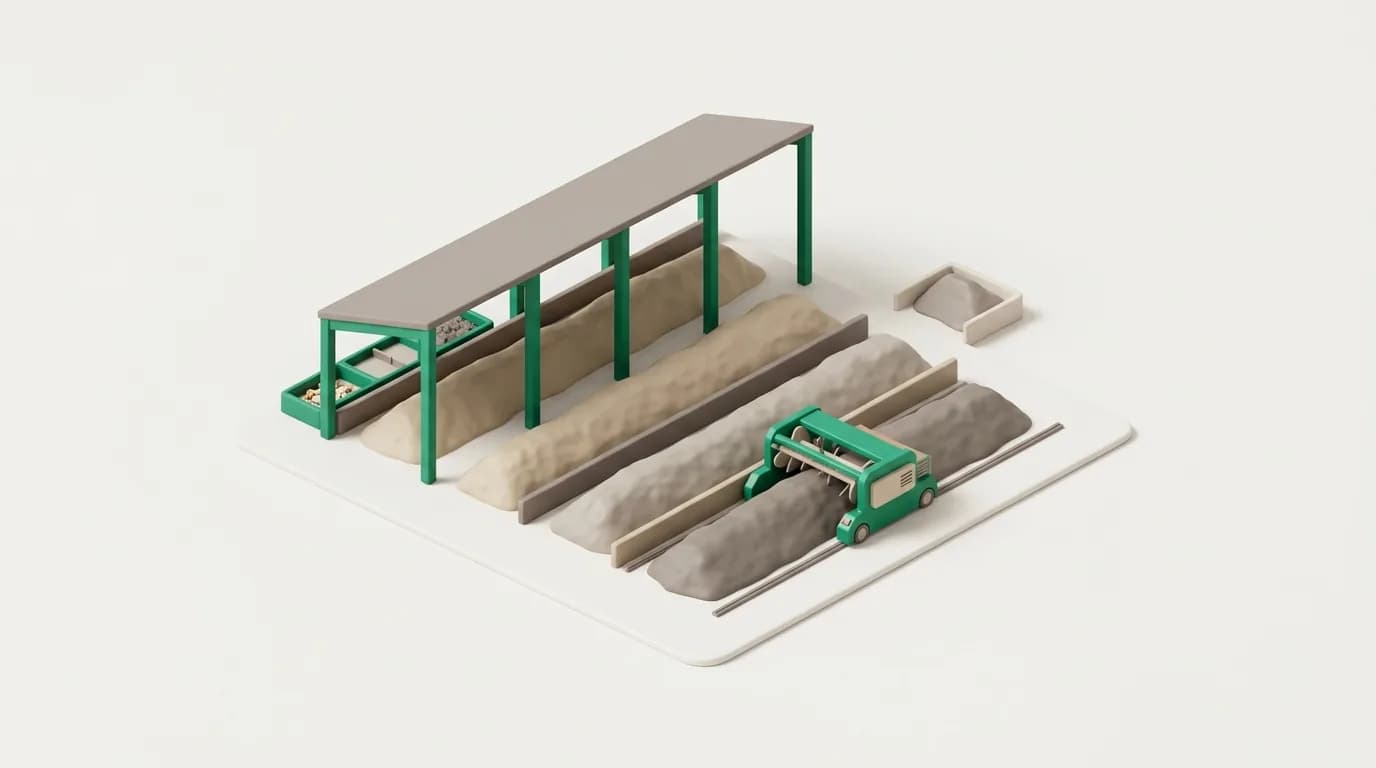
Composting is an aerobic process: the waste is aerated and micro-organisms release most of the carbon as CO₂. That CO₂ is biogenic — it is the return of carbon that plant growth took from the atmosphere — and is not counted in the GWP100 indicator that excludes biogenic CO₂. What is counted is the plant's electricity and diesel consumption and the small amounts of methane and nitrous oxide that escape from partially anaerobic zones inside the windrows. The ecoinvent 3.12 dataset 'treatment of biowaste, industrial composting | RoW' puts the sum at roughly 0.061 kg CO₂e per kilogram. The difference from open dumping is 0.466 kg CO₂e/kg: about 466 tonnes of CO₂e avoided for a thousand tonnes of kitchen waste.
The same factor is not used for home or small-scale composting; in poorly aerated heaps the methane share rises and the credit falls. A corporate balance should document that the composting plant is licensed and actively aerated.
Anaerobic digestion: biogas and digestate
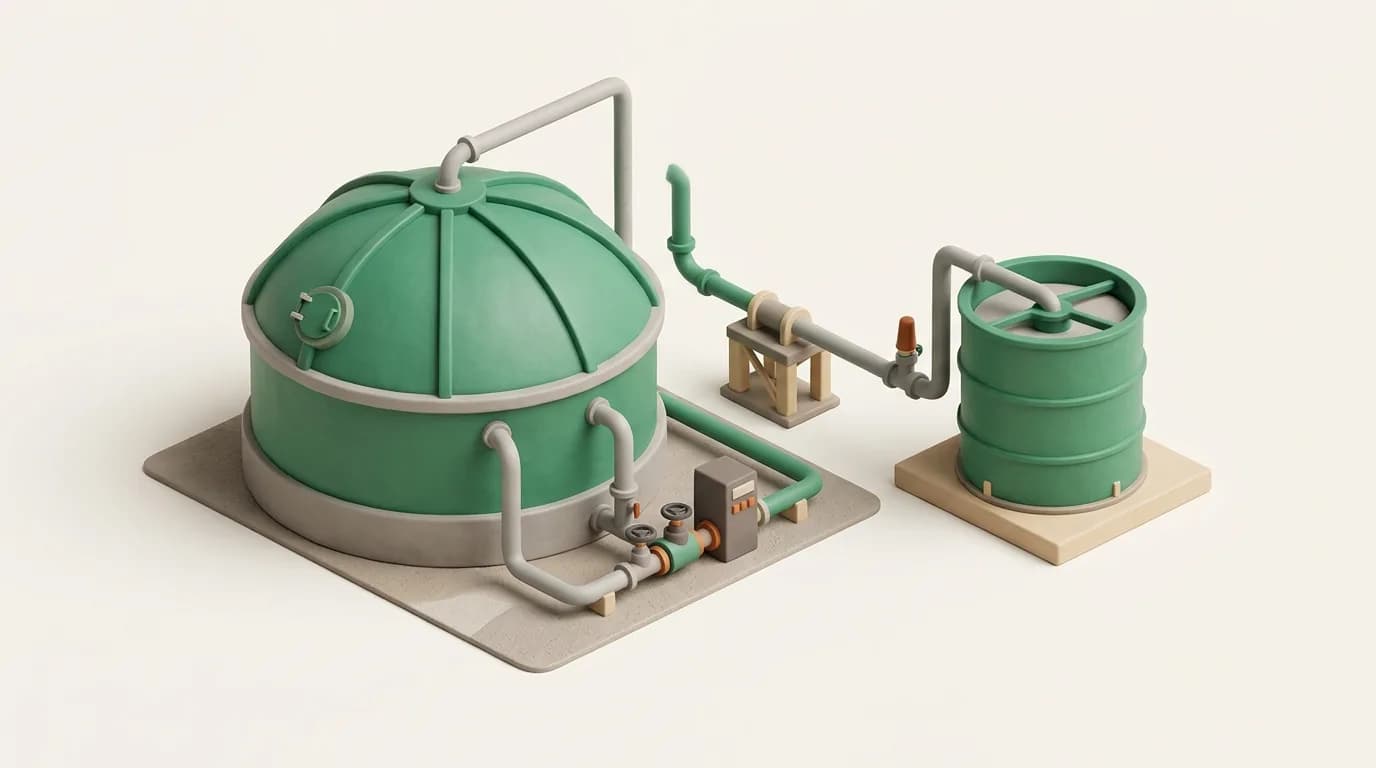
In anaerobic digestion (a biogas plant) methane production is deliberate: the biogas formed in a sealed reactor is collected and converted to electricity and heat in a CHP engine, or upgraded and injected into the grid as biomethane. The process's own emissions — reactor leakage, engine exhaust, digestate storage — come to roughly 0.117 kg CO₂e/kg in the ecoinvent 3.12 dataset 'treatment of biowaste by anaerobic digestion'; higher than composting, because methane slip can never be brought to zero. The difference from open dumping drops to 0.411 kg CO₂e/kg. The energy the plant generates, however, can be modelled as a separate energy credit outside the material credit: the more carbon-intensive the grid electricity it replaces, the larger that credit. Whether this second credit is added is a scoping decision, and when two plants are compared the same decision must be applied to both.
On treatment emissions alone, composting leads; once the energy credit is added and the grid being replaced is of medium-to-high carbon intensity, as in Turkey, biogas usually moves ahead. Which is 'better' cannot be said before the counterfactual and the energy-credit decision have been settled.
Reference values and a worked example
- Open dump (counterfactual): 0.528 kg CO₂e/kg — ecoinvent 3.12, treatment of biowaste, open dump | RoW, GWP100 IPCC 2021
- Industrial composting: 0.061 kg CO₂e/kg — same database, industrial composting | RoW
- Anaerobic digestion: 0.117 kg CO₂e/kg — same database, anaerobic digestion | RoW, excluding the energy credit
- Composting credit: 0.528 − 0.061 = 0.466 kg CO₂e/kg wet waste
- Biogas credit: 0.528 − 0.117 = 0.411 kg CO₂e/kg wet waste, excluding the energy credit
- Example: 1,248 t of organic waste per year via composting → 1,248,000 kg × 0.466 ≈ 582 t CO₂e avoided
These values belong to the RoW (rest of world) geography and are per wet mass — no dry-mass correction is applied to organic waste, because the datasets already take wet waste as their input. Where plant-specific measurements exist (gas leakage, energy consumption), a factor derived from them may be preferred over the ecoinvent one; but then data of equivalent quality is needed for the counterfactual route too. A difference with plant data on one side and generic data on the other is inconsistent.
Why CED_NR can come out negative
The primary energy indicator surprises people when it comes to organic waste. Open dumping has no measurable energy input in ecoinvent — the waste is tipped somewhere, and that is all. A composting plant, by contrast, consumes electricity and diesel for aeration fans, turners and loaders. The non-renewable cumulative energy demand (CED_NR) difference therefore comes out negative: composting consumes roughly 0.4 MJ of additional primary energy per kilogram relative to the counterfactual. In the balance this line must be read as 'energy consumption', not 'energy saving'. A stream that yields a large credit in the greenhouse gas balance while being a small burden in the energy balance is not a contradiction; the two indicators measure different things and the report should show them separately. If the energy generated on the biogas route is counted, CED_NR turns positive — again a matter of scoping.
ISO 14021 and biogenic carbon: what may be claimed
Communicating an organic waste credit is subject to two rules. The first is the claims discipline of ISO 14021: an 'avoided emission' is a difference computed against a counterfactual, not a reduction deducted from the organisation's own inventory, and it cannot be used like an offset. The report may say 'X tonnes of CO₂e avoided'; it may not say 'our carbon footprint fell by X tonnes'. The second concerns biogenic carbon: the CO₂ released in composting is biogenic and counts as zero in the GWP100 variant that excludes biogenic CO₂; but that does not mean composting 'stores carbon'. The long-term carbon retention of compost worked into soil is a separate scientific debate and should not enter a corporate balance as a credit. Methane, on the other hand, is counted at its full GWP even though it is biogenic in origin — avoided methane is the real source of the credit.
Frequently asked questions
- How is the recovery credit of organic waste calculated?
- The credit is the difference between the factor of the counterfactual disposal route and that of the actual treatment route, multiplied by the wet mass of waste; yield and substitution ratio are taken as 1.0. On ecoinvent 3.12 the difference between open dumping (0.528) and industrial composting (0.061) is 0.466 kg CO₂e/kg; roughly 466 tonnes of CO₂e avoided per thousand tonnes of waste.
- Which gives the larger credit, composting or biogas?
- On treatment emissions alone composting leads: 0.061 against 0.117 kg CO₂e/kg. If the electricity and heat generated by the biogas plant are added as a separate energy credit and the grid being replaced is carbon-intensive, biogas usually moves ahead. The result depends on the scoping decision; both alternatives must be compared under the same scope.
- Should open dumping or landfill be chosen as the counterfactual?
- The route the waste would actually have taken had it not been recovered. In a region served by a landfill with gas collection, an open-dump assumption overstates the credit. The choice and its justification must be stated in the report, and the calculation should show as a sensitivity how far the credit falls when the counterfactual changes.
- Why does the energy saving come out negative for organic waste?
- Open dumping has no measurable energy input in ecoinvent, whereas a composting plant consumes electricity and diesel. The non-renewable cumulative energy demand difference is therefore negative — roughly 0.4 MJ of additional consumption per kilogram. That is not an error but the correct result of the indicator, and the report should show it as consumption.
- Can avoided emissions be deducted from the corporate carbon footprint?
- No. An avoided emission is a difference computed against a counterfactual; under ISO 14021 and GHG Protocol logic it cannot be deducted from the organisation's own Scope 1-2-3 inventory and cannot be used in place of an offset. It is reported as a separate balance, worded as 'avoided' and with the counterfactual stated explicitly.
Tags
- recovery
- recycling credit
- organic waste
- composting
- biogas
- waste management
- methane
- biogenic carbon
Related reading
All articles in Data & Methods- Data & Methods
Recovery credits by material: from PET to aluminium
A tonne of recovered aluminium and a tonne of paper do not earn the same credit. The primary and secondary route, the order of magnitude of the credit and the specific trap for each of six materials.
12 min read - Data & Methods
Recovery calculation: how to quantify avoided CO₂e and energy
A recovery calculation measures how much greenhouse gas and primary energy is avoided compared with the scenario in which a waste stream is not recovered. The formula, the four inputs and a worked 100-tonne PET example.
11 min read - Data & Methods
Energy recovery or material recycling? Comparing the credits
The same tonne of plastic displaces electricity if burned and granulate if recycled — but the two credits are not the same size and cannot both be granted to one stream. The waste hierarchy, EN 15804 Table 13 and the formulae.
11 min read - Data & Methods
Recovery yield and substitution ratio: product per kg of waste
The two quiet multipliers of a recovery credit: yield, which describes process loss, and the substitution ratio, which describes quality. Catalogue yields by material, the moisture correction and downcycling.
10 min read