Biogenic carbon and end-of-life scenarios: EN 15804 §7.4.4 in practice
The -1/+1 rule, per-material biogenic carbon declaration, and how reuse / recycling / energy-recovery scenarios play out in GWP-biogenic.
By clca Editorial TeamLast updated
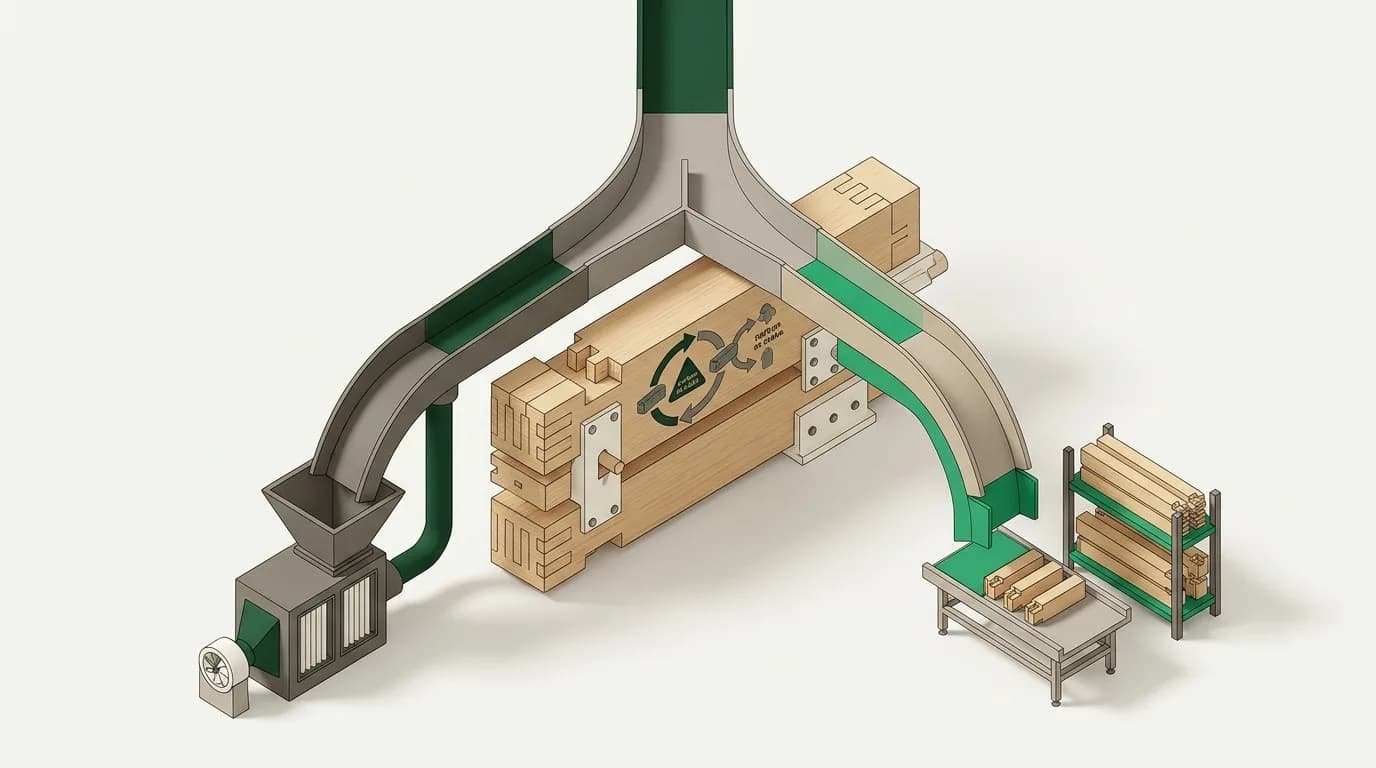
Every product containing timber, cellulose, hemp or bio-based polymer temporarily stores carbon drawn from the atmosphere. How to account for that carbon in an EPD is one of the most frequently misapplied parts of EN 15804+A2: §7.4.4. The typical symptom of misapplication is a "carbon negative" product claim showing a large negative GWP in A1-A3 while omitting the end of life.
The -1/+1 rule: entry and exit always match
The rule is simple: biogenic carbon entering the product system is booked as -1 kg CO₂/kg CO₂ (removed from the atmosphere) and booked back as +1 when it leaves (decay, incineration, or transfer to the next system). Because the boundary is cradle-to-grave, the net effect on the total is zero — biogenic carbon storage is not a permanent gain in GWP-total. The benefit is timing only, and EN 15804+A2 does not reward that timing.
The §7.4.4 declaration rules
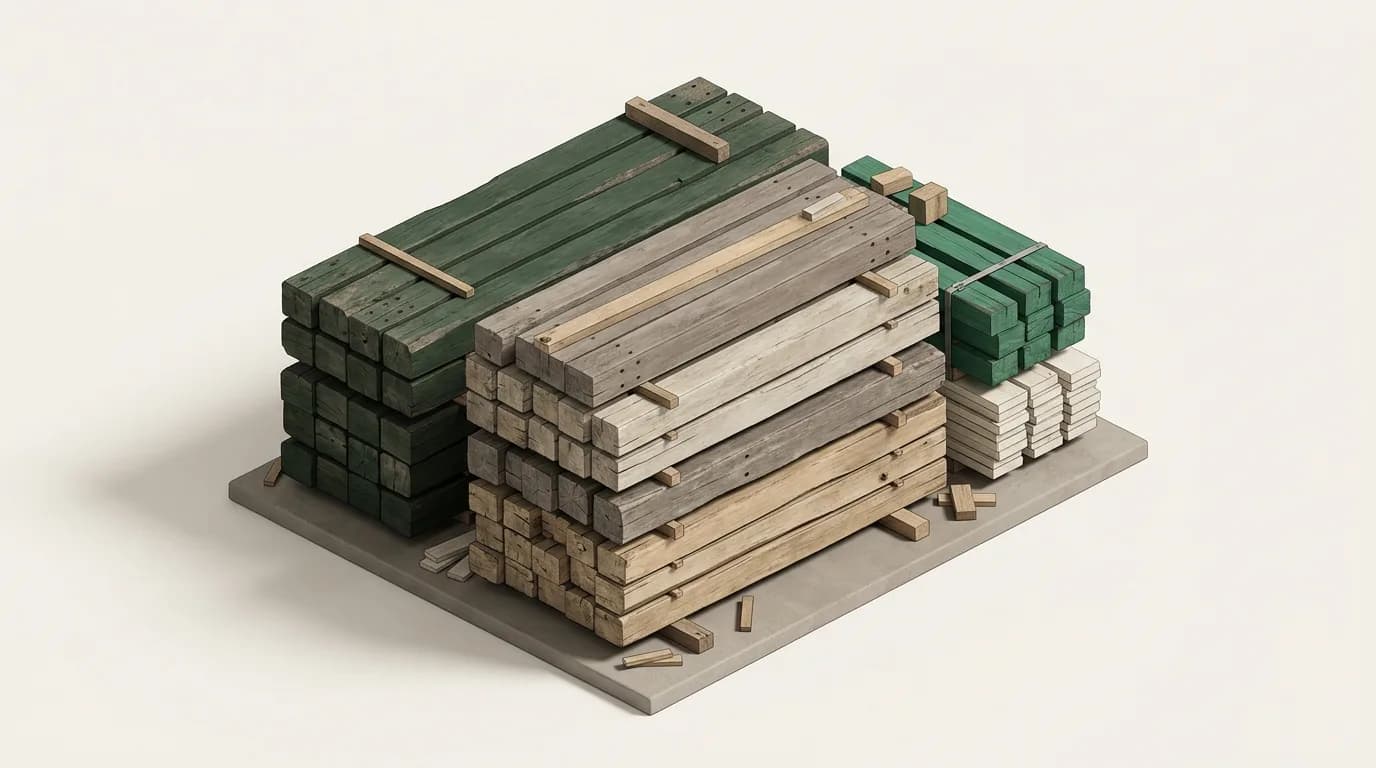
- Biogenic carbon content in the product is declared separately in kg C (not kg CO₂eq)
- Biogenic carbon in packaging is declared on a separate line from the product
- The declaration may be omitted when biogenic carbon is below 5% of product mass
- GWP-biogenic is reported as a separate component inside GWP-total — it cannot be hidden
- Packaging carbon exits the system in A5 (when packaging waste is processed)
Three end-of-life scenarios, three different profiles
Where the +1 exit of biogenic carbon happens depends on the scenario. In reuse, carbon transfers to the next product system — exit in C3, transfer information in D. In recycling, carbon likewise travels with the secondary material. In energy recovery, carbon returns to the atmosphere as combustion emissions in C3, and the substituted energy books a benefit in D. In landfill, partial decay produces methane — and although biogenic in origin, CH₄ is characterised far more heavily; for timber, the landfill scenario is therefore usually the worst profile.
The relationship with module D
The C3/C4 emissions of the end-of-life scenario and the substitution benefits in D are linked but never netted against each other. In the energy-recovery scenario, combustion emissions are booked in full in C3; the avoided emissions of substituted grid energy are reported separately in D. This separation is the only way to compare scenarios honestly.
Three common mistakes
First: declaring the -1 entry in A1-A3 while leaving the C modules "MND" — since C1-C4 and D are mandatory in EN 15804+A2, the verifier rejects this. Second: booking packaging biogenic carbon on the product's line — carbon that should exit in A5 drifts into C3. Third: mixing kg C with kg CO₂eq — the declaration wants kg C, the conversion factor is 44/12 ≈ 3.67, and applying it twice corrupts the result.
Tags
- biogenic carbon
- EN 15804 7.4.4
- GWP-biogenic
- end-of-life scenario
- carbon storage
- energy recovery
Related reading
All articles in Platform- Platform
A guide to the EN 15804 result tables: how to read Tables 8, 9, 11, 12, 13
The numerical core of an EPD is five result tables: core impact, additional impact, resource use, waste and output flows. What they mean, row by row.
12 min read - Data & Methods
Scenario analysis: how end-of-life assumptions decide the result
Nobody knows what recycling infrastructure will look like in fifty years. How to work with that uncertainty and report scenarios honestly.
10 min read - Standards
Module D: beyond system boundaries — claiming the recycle credit correctly
Module D reports future benefits from recycling. End-of-waste criteria, secondary material quality, steel 90% vs plastic 30% examples.
10 min read - Fundamentals
What is the circular economy? And how is it measured with LCA?
Circularity is not an environmental benefit in itself — it has to be measured. When recycling wins, and when it does not.
10 min read