Energy recovery or material recycling? Comparing the credits
The same tonne of plastic displaces electricity if burned and granulate if recycled — but the two credits are not the same size and cannot both be granted to one stream. The waste hierarchy, EN 15804 Table 13 and the formulae.
By clca Editorial TeamLast updated
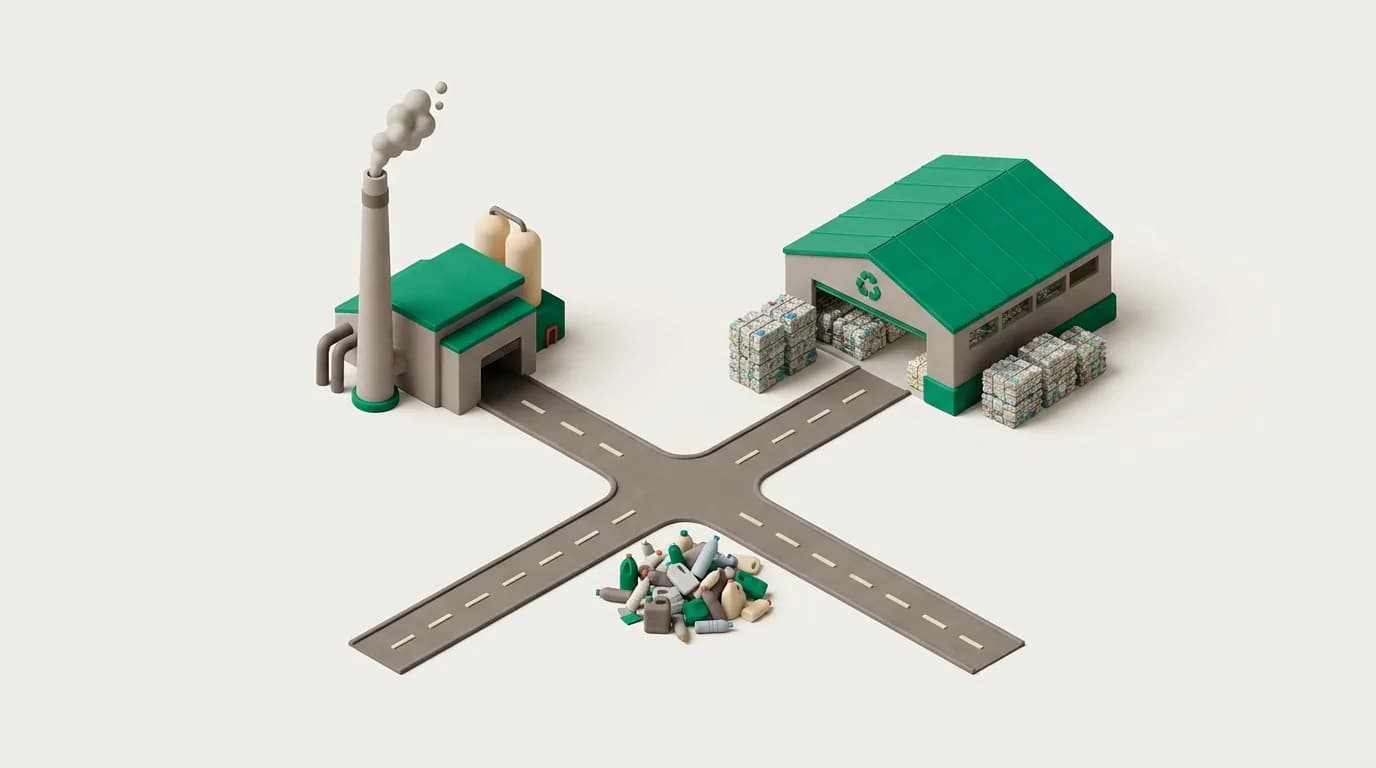
Energy recovery is the displacement of another energy source by the heat or electricity obtained from burning waste; material recycling is the displacement of virgin raw material by processing the waste. Both produce a recovery credit, but the formula, the size and the product displaced differ. For fossil-based plastics the material route almost always earns the larger credit and incineration carries its own CO₂ burden; for biomass-based paper and wood the balance is closer. One rule holds for every material: the same kilogram of waste cannot go down both routes, and so cannot earn both credits. This article starts with the waste hierarchy, explains the output flow classification in EN 15804+A2, sets the two credit formulae side by side and compares them for plastics and paper.
The waste hierarchy: why recycling ranks above energy
The EU Waste Framework Directive and Turkey's Zero Waste legislation use the same ranking: prevention, preparing for reuse, recycling, other recovery (including energy), disposal. Energy recovery sitting below recycling is not arbitrary; a route that preserves the material's function saves more primary resources than one that only uses its calorific value. A kilogram of polyethylene that becomes granulate again saves both the energy and the feedstock of polymer production; burned, only the chemical energy inside it is used once and its carbon goes to the atmosphere. The hierarchy is the summary of a calculation, and a recovery balance confirms that summary material by material — or, for some streams such as paper, adds nuance to it.
EN 15804+A2 Table 13: MFR, MER, CRU

EN 15804+A2 splits the flows leaving a product system into three classes in Table 13: components for reuse (CRU), materials for recycling (MFR) and materials for energy recovery (MER). Exported energy (electricity EEE, heat EET) sits on separate lines. The point of the classification is that every kilogram is assigned a single fate: in module C3 a material leaves as either MFR or MER, never both. The benefit in Module D is calculated according to that assignment — the displaced virgin material for MFR, the displaced energy carrier for MER. A corporate recovery balance applies the same discipline at site scale: every stream is defined by its route, and the route determines which credit formula runs.
The two formulae side by side
The material credit is the familiar recovery formula: dry mass × yield × substitution ratio × (primary material factor − secondary material factor). The energy credit follows a different chain. First the net calorific value of the waste (LHV, MJ/kg) is multiplied by the conversion efficiency of the incineration plant — 20–25 per cent is typical for an electricity-only plant, 60–80 per cent in total for a plant delivering heat and power together. The useful energy obtained is then multiplied by the emission factor of the displaced carrier: the grid factor for electricity, usually a natural gas boiler for heat. That is the credit. But incineration carries its own burden too: the CO₂ released by burning fossil-carbon waste, plus plant operation. Net energy credit = avoided emissions of the displaced energy − combustion emissions − plant burden. That this net is frequently negative for fossil plastics is the numerical counterpart of the hierarchy.
- Material credit = dry mass × yield × substitution × (primary − secondary material factor)
- Gross energy credit = dry mass × net calorific value × conversion efficiency × emission factor of the displaced energy
- Net energy credit = gross energy credit − combustion CO₂ (fossil carbon) − plant operating burden
- For waste with biogenic carbon (paper, wood, organics) the combustion CO₂ is not counted in the biogenic-excluded GWP100 variant
- Only one formula runs per stream; material if the route is MFR, energy if it is MER
The plastics example: why the incineration credit turns negative
One kilogram of polyethylene has a net calorific value of roughly 43 MJ. In an electricity-only plant at 25 per cent efficiency this gives about 10.8 MJ, or 3 kWh of electricity. If that electricity displaces a grid at around 0.4 kg CO₂e/kWh, the gross credit is roughly 1.2 kg CO₂e per kilogram. But burning polyethylene releases 3.14 kg of fossil CO₂, a figure that follows directly from its chemical formula. The net result is roughly −1.9 kg CO₂e per kilogram: a burden, not a credit. In a plant that also recovers heat the gross credit grows, but it rarely exceeds the combustion CO₂. When the same kilogram of polyethylene becomes granulate again through mechanical recycling, the gap between virgin and recycled granulate gives a positive credit of the order of 1–2 kg CO₂e per kilogram, depending on the plant. The picture is the same for PET: the calorific value is lower (about 23 MJ/kg), combustion CO₂ about 2.3 kg/kg, and the material credit sits in the 1.5–2.5 kg CO₂e/kg range.
The conclusion is not that energy recovery is pointless for plastics; it still ranks above landfill and is the only reasonable route for the mixed, contaminated fraction that cannot be recycled. The conclusion is that the credits of the two routes for the same tonnage are not comparable: burning recyclable plastic turns a positive credit into a negative one.
Paper and wood: the biogenic nuance
For biomass-based material the balance shifts. The CO₂ released by burning paper and wood is biogenic; in the variant of IPCC 2021 GWP100 that excludes biogenic CO₂ it counts as zero. The combustion burden on the energy route therefore disappears and the gross credit approaches the net credit — for wood, at 15–18 MJ/kg dry net calorific value in a combined heat and power plant, a credit of a few hundred grams of CO₂e per kilogram is possible. On the material route, meanwhile, the credit for paper can come out close to zero because virgin kraft production already runs on biomass energy. This does not mean the hierarchy reverses for paper: keeping the fibre in the loop defers the demand for virgin wood in every future cycle and protects the forest carbon stock, a benefit that a single-year GWP calculation does not show. The balance must state explicitly which route was chosen for paper and wood and why, and on the energy route it must make non-renewable CED the headline — total CED shows the burned wood's own energy as a saving.
Double counting: one stream, one route, one credit
This is the strictest rule of a recovery balance. A tonnage earns either a material credit or an energy credit; a calculation that adds the two reports a physically impossible scenario — the same kilogram becoming granulate and burning. In practice the error leaks in from two places. First, the fraction rejected by the recycling plant (sorting loss) going to incineration: that is a legitimate second stream, but its mass comes out of the yield loss and cannot be counted on top of the original tonnage. Second, the receiver's route being unknown: the phrase “sent to recovery” is not enough for a material credit; what the receiver actually did must be documented. Where the route is uncertain the conservative option is chosen — for plastics that may mean granting no credit at all.
Decision matrix
- Sorted, clean fossil plastic (PET, PE, PP) — material route; energy route net negative
- Mixed, contaminated plastic fraction — energy route is the only reasonable option; credit small or negative, still above landfill
- Metals (steel, aluminium) — always the material route; no calorific value, energy credit undefined
- Glass — material route (cullet); does not burn
- Paper and board — material route first; credit small, the benefit lies in the fibre loop and avoided landfill
- Painted or impregnated wood — energy route; clean wood takes the material route (particleboard)
- Organic waste — neither material nor classic energy; a treatment-type stream (compost, biogas) calculated separately
Frequently asked questions
- How is an energy recovery credit calculated?
- The net calorific value of the waste (MJ/kg) is multiplied by the plant's conversion efficiency to give useful energy; that energy is multiplied by the emission factor of the displaced carrier (grid electricity or natural gas heat) to give the gross credit. For fossil-carbon waste the combustion CO₂ and plant burden are deducted; for plastics the net is mostly negative.
- Why does burning plastic not earn a carbon credit?
- Burning polyethylene releases 3.14 kg of fossil CO₂ per kilogram, while the displaced electricity at 25 per cent efficiency avoids roughly 1.2 kg CO₂e. The net result is about −1.9 kg CO₂e. Heat recovery enlarges the gross credit but rarely exceeds the combustion CO₂.
- What do MFR, MER and CRU mean?
- They are the output flow classes in EN 15804+A2 Table 13: MFR is material for recycling, MER material for energy recovery, CRU components for reuse. Every kilogram is assigned to a single class and the benefit in Module D is calculated according to that assignment.
- Can the same waste stream earn both a material and an energy credit?
- No. The same kilogram cannot both become granulate and burn; adding the two credits is double counting. Sorting loss going to incineration is a legitimate second stream, but its mass comes out of the yield loss and is not added to the original tonnage.
- Can energy recovery be better than material recycling for paper?
- In a single-year GWP calculation the two can come out close, because combustion CO₂ is biogenic and virgin kraft production already runs on biomass. But keeping the fibre in the loop defers future demand for virgin wood and protects the forest carbon stock, which is why the material route stays ahead in the hierarchy.
Tags
- recovery
- recycling credit
- energy recovery
- waste hierarchy
- Module D
- waste management
- circular economy
- end-of-life scenario
Related reading
All articles in Data & Methods- Data & Methods
Recovery yield and substitution ratio: product per kg of waste
The two quiet multipliers of a recovery credit: yield, which describes process loss, and the substitution ratio, which describes quality. Catalogue yields by material, the moisture correction and downcycling.
10 min read - Data & Methods
Recovery calculation: how to quantify avoided CO₂e and energy
A recovery calculation measures how much greenhouse gas and primary energy is avoided compared with the scenario in which a waste stream is not recovered. The formula, the four inputs and a worked 100-tonne PET example.
11 min read - Data & Methods
Scenario analysis: how end-of-life assumptions decide the result
Nobody knows what recycling infrastructure will look like in fifty years. How to work with that uncertainty and report scenarios honestly.
10 min read - Data & Methods
Recovery of organic waste: compost, biogas and open dumping
Organic waste substitutes no product; the credit comes entirely from avoided methane. Open dumping, landfill, composting and biogas compared on ecoinvent 3.12 data.
12 min read