Corporate recovery balance: from waste streams to a GHG report
The climate benefit of the waste a site sends to recycling does not enter the Scope 3 inventory, but it can be reported as a separate balance. Data collection, matching, double-counting rules and claim wording that complies with ISO 14021.
By clca Editorial TeamLast updated
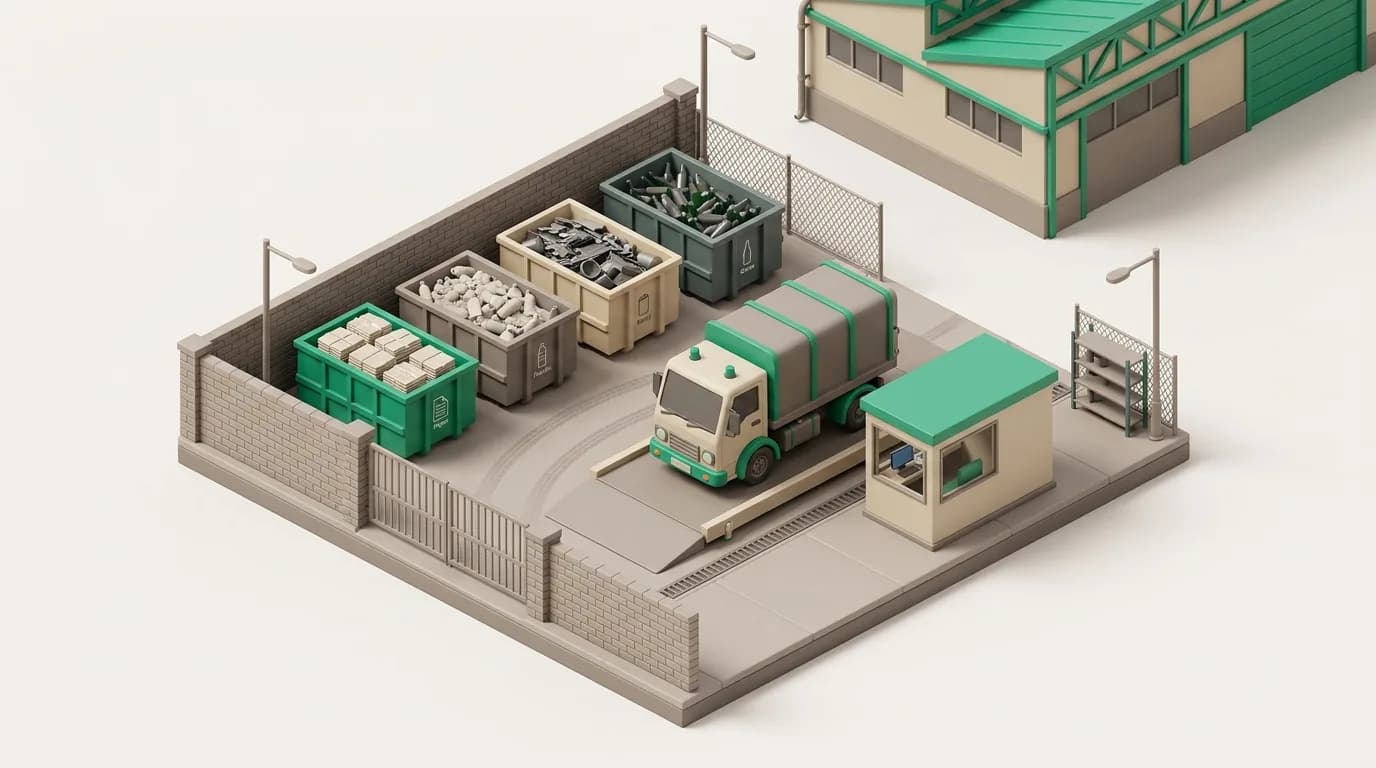
A corporate recovery balance is the report that shows, stream by stream and in total, the greenhouse gas emissions and primary energy avoided by the waste streams an organisation separately collected and sent to recovery in a given period. It is not part of the corporate carbon inventory; it is a second document that stands beside it and answers a different question. The inventory asks “how much did we emit?”; the balance asks “how much would others have emitted had we not recovered?”. As long as that distinction is preserved, the balance is a powerful communication and management tool; once it blurs, it turns into a greenwashing risk. This article explains why the balance is built separately, what data feeds it, the matching and double-counting rules, claim wording that complies with ISO 14021, and the transparency elements a report cannot do without.
Why beside the inventory rather than inside it?
Under the GHG Protocol the treatment of waste generated by a site is reported in Scope 3 Category 5 (waste generated in operations), and that category counts burden only: collection, transport and processing emissions at the recycling plant. The virgin raw material production that recycling avoids at another manufacturer lies outside the waste generator's system boundary. The Protocol does not allow such benefits to be deducted from the inventory; the three scopes are summed and not netted against offsets or avoided emissions. The same principle holds in ISO 14064-1. “Avoided emissions” is therefore a legitimate concept, but its proper place is outside the inventory: reported as a benefit occurring beyond the system boundary, with its own calculation rules and its own document. It is the same logic by which Module D in EN 15804 is never added to the A1-C4 total.
What data is collected?

The data source for the balance already exists at any site that has set up a Zero Waste system: separate collection records, weighbridge tickets, waste transfer forms and delivery documents from licensed receivers. What is usually missing is the second level of detail — where the stream actually went and in what quality. For a balance, the following fields must be completed for every stream:
- Stream definition — the material, not the trade name: “sorted PET bottles”, “mixed paper and board”, “aluminium beverage cans”
- Quantity and unit — wet mass from the weighbridge ticket, in tonnes or kg, with opening and closing stock corrections
- Moisture and contamination share — a measurement where one exists, otherwise a conservative assumption for the stream
- Route — mechanical recycling, remelting, pulping, energy recovery; determines whether the stream earns a material or an energy credit
- Receiver — the licensed recovery facility and its country; needed for the grid correction and the geography choice
- Documentation — transfer form, delivery note, the receiver's recovery declaration; no credit is granted to an undocumented stream
The period is the calendar year and the same base year as the inventory is used, so that the two documents can be read side by side. The stock correction must not be forgotten: bales still waiting on site at year end have not yet been recovered and do not enter that year's balance.
Matching: catalogue, suggestion, manual selection
Matching every stream to a primary (displaced) and a secondary (actual) ecoinvent activity is the technical core of the balance, and that match cannot be extracted automatically from the database; it is a judgement. The scalable route has three layers. The first is a curated catalogue: for common streams such as PET, paper, glass, steel, aluminium and wood, verified activity pairs, yields and caveats are ready; the match is deterministic and auditable. The second is an AI assistant that proposes from a candidate list for names not in the catalogue; the proposal does not enter the calculation until the user confirms it, and the model never generates a free-text activity name, it only selects from the candidates given. The third is manual matching, where an expert user picks the activity directly from ecoinvent. The calculation is not run while a single stream remains unconfirmed.
Double-counting rules
Double counting appears in a recovery balance in three forms, and all three are prevented by rule. The first is within-stream double counting: the same tonnage cannot earn both a material substitution credit and an energy recovery credit; a kilogram of plastic has either become granulate again or been burned. The second is double counting between parties: the recycler's own product EPD treats the secondary raw material as burden-free under the cut-off rule and reports its own Module D, while the waste generator's balance shows the same benefit as avoided emissions. Because the two documents answer different questions and neither is deducted from an inventory, they can coexist — but the balance must never use “our reduction” language. The third is scenario double counting: optional credits such as avoided landfill (methane) are not mixed into the baseline, but shown in a separate upper scenario only when a counterfactual disposal route is defined.
ISO 14021 and claim wording
If the results of the balance are to be used in external communication, the rules ISO 14021 sets for self-declared environmental claims apply: the claim must be accurate, specific, verifiable and not misleading, and its scope and method must be accessible. In practice three word choices are decisive. “Avoided emissions” is correct; “reduced emissions” is wrong because the organisation's own emissions have not fallen. “Credit” is a technical term inside the balance; in external communication it should be avoided because it evokes “carbon credit” — the balance does not generate an offset, does not create a tradable unit and cannot underpin a net zero claim. “Approximately” and range wording are a sign of accuracy rather than weakness; a single precise figure hides the uncertainty in the inputs.
- Correct: “The 1,850 tonnes of waste we sent to recovery in 2025 contributed to avoiding approximately 2,700 t CO₂e of emissions (preliminary calculation, based on ecoinvent 3.12)”
- Wrong: “We reduced our carbon footprint by 2,700 tonnes through recycling”
- Wrong: “We are carbon neutral thanks to our recycling credits”
- Correct: “The calculation method, stream-level data sources and assumptions are in the annex of the report”
Transparency the report cannot do without
The credibility of a recovery balance comes not from the size of the result but from its traceability. The report must contain a data-sources table listing, for each stream, the name and geography of the primary and secondary activity, the raw GWP and CED factors, the yield and the substitution ratio; without it no third party can recalculate a single line. The cover states plainly that the calculation is preliminary and has not been independently verified — a notice that is not removed until the document is verified. Low-confidence streams (those calculated with proxy data) are flagged separately. If more than half of the total credit comes from a single stream, that concentration is shown explicitly. The dataset version (ecoinvent 3.12) and the indicator definitions (IPCC 2021 GWP100 excluding biogenic, non-renewable CED) appear in the colophon; when the version changes, an old balance cannot be compared with the new one without recalculation.
The link to the Zero Waste certificate
In Turkey, organisations covered by the Zero Waste Regulation already report their separate collection data to the national system, and the certificate grade rests on that data. The recovery balance is built on top of that data but says something different: the certificate shows the system is in place and working; the balance quantifies the climate and resource benefit of that system. The two complement each other. The tonnage collected for the certificate is the input of the balance; the balance turns the certificate into a concrete figure for tenders, customer questionnaires and the sustainability report. Building the balance on the same base year and the same site boundary as the inventory allows the three documents — inventory, Zero Waste record and balance — to be read consistently.
Frequently asked questions
- Is a recovery balance part of the Scope 3 inventory?
- No. Scope 3 Category 5 counts only the burden of treating the waste. The virgin production that recycling avoids at another manufacturer lies outside the system boundary, and the GHG Protocol does not allow it to be deducted from the inventory. The balance is a separate document that stands beside the inventory.
- Can avoided emissions be used in a carbon neutral claim?
- It cannot. Avoided emissions are not an offset, do not create a tradable unit and do not reduce the organisation's own emissions. Wording that complies with ISO 14021 is “contributed to avoiding”; “we reduced” or “we are neutral” would be considered misleading.
- Which documents are needed for a balance?
- For every stream a weighbridge ticket or weighing record, the waste transfer form, the licensed receiver's delivery or recovery declaration and, where possible, a moisture measurement. No credit is granted to an undocumented stream; the documents are referenced in the annex so a third party can recalculate the line.
- Isn't it double counting if the same waste appears in the recycler's EPD and in our balance?
- The two documents answer different questions and neither is deducted from an inventory: the EPD describes the product's profile, the balance the benefit of the waste generator's system. Double counting arises when the balance slides into “our reduction” language, or when the same tonnage is granted both a material and an energy credit.
- Does a balance require independent verification?
- It is not mandatory, but it is recommended if the balance will be used externally. Until verified, the report carries the notice “preliminary calculation, not independently verified”. What makes the verifier's job possible is the data-sources table listing each stream's activity, factors and yield.
Related reading
All articles in Corporate Carbon- Data & Methods
Recovery calculation: how to quantify avoided CO₂e and energy
A recovery calculation measures how much greenhouse gas and primary energy is avoided compared with the scenario in which a waste stream is not recovered. The formula, the four inputs and a worked 100-tonne PET example.
11 min read - Corporate Carbon
GHG Protocol Scope 1, 2 and 3: drawing the boundaries correctly
The three scopes answer different questions. Organisational boundary choices, control approaches and what Scope 3’s fifteen categories mean in practice.
12 min read - Corporate Carbon
Turning EPD data into a Scope 3 inventory
The EPDs you hold are the best data source for a corporate inventory — if you map the right modules to the right categories. Practical mapping rules.
10 min read - Corporate Carbon
Carbon neutral, net zero, climate neutral: what the claims actually require
Three terms, three different evidence requirements. Offsetting mechanisms, the permanence problem and where greenwashing begins.
10 min read