System boundary: cradle-to-gate, -grave, -cradle — which when?
System-boundary choice defines which life cycle modules your study includes. The three core scopes and selection criteria.
By clca Editorial TeamLast updated
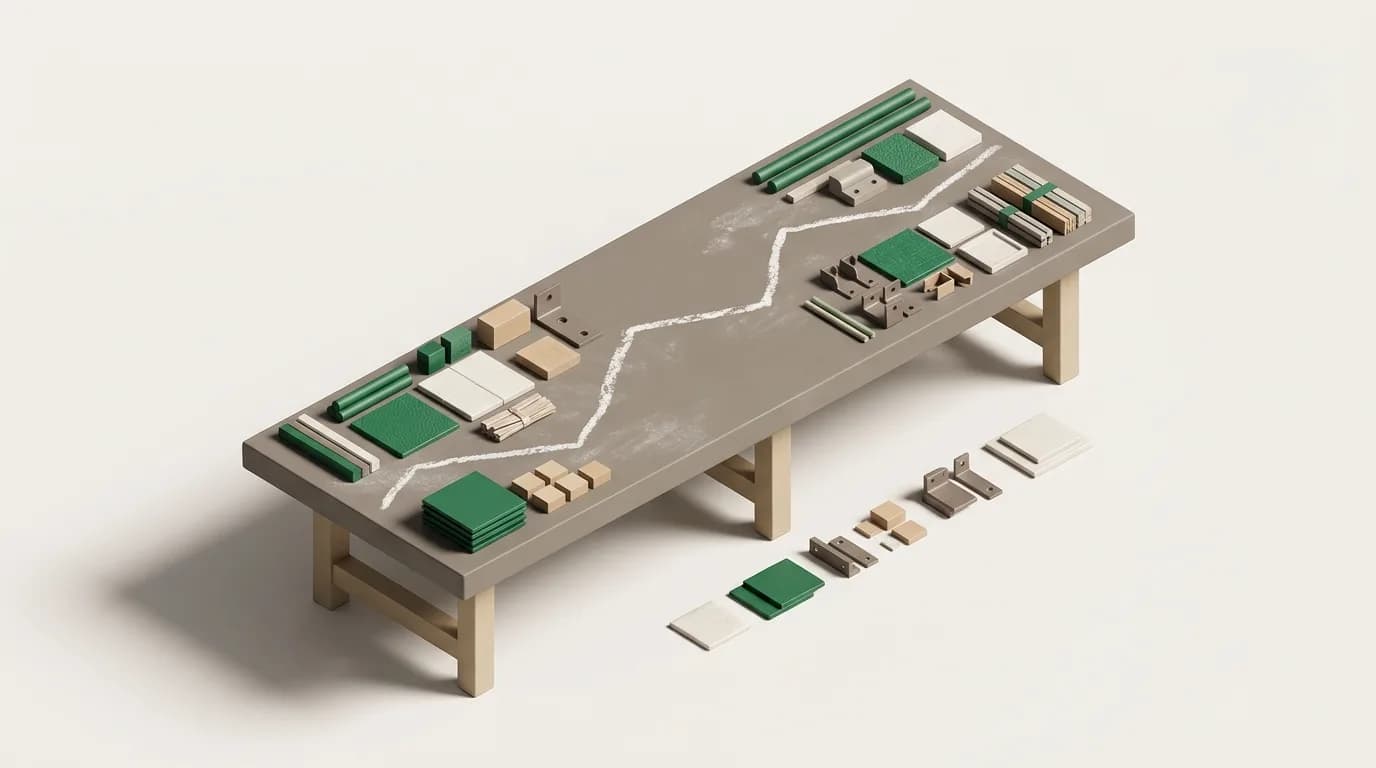
The system boundary is the most consequential methodological decision in an LCA — it defines what is included and what is left out. The wrong boundary distorts results systematically. EN 15804+A2 supports three main scopes: cradle-to-gate, cradle-to-grave and cradle-to-cradle.
Cradle-to-gate (A1-A3)
From raw materials to the factory gate. Includes A1 (raw material supply), A2 (transport) and A3 (manufacturing). It is the default scope for construction materials because the product passes out of "manufacturer responsibility" beyond this point — installation, use, and end-of-life rest with the contractor or building owner. Cradle-to-gate is the minimum EPD scope; A4-D modules are flagged MND in the modulary table.
Cradle-to-grave (A1-C4)
From raw materials to disposal — covers the entire life cycle. A1-A5 (production and construction), B1-B7 (use), C1-C4 (end of life). Green-building certifications (LEED, BREEAM, DGNB) require cradle-to-grave scope; building-level LCA (EN 15978) depends on it. Module D is optional within this scope — reported if available, MND otherwise.
Cradle-to-cradle (A1-D)
Cradle-to-cradle extends cradle-to-grave with Module D — reporting beyond-system-boundary benefits (the recycle credit). The term references circular-economy thinking — emphasising that the product creates value in its second and third lives. Recycle-heavy products like steel and aluminium prefer this scope because Module D yields a positive credit. For plastics, Module D contributions are modest, so the gap to cradle-to-grave is smaller.
Choosing the right scope in 4 questions
- 1. What is my EPD use case? Marketing (cradle-to-gate suffices), building certification (cradle-to-grave required), environmental claim (cradle-to-cradle preferred)
- 2. Is the production geography the same as installation/end-of-life geography? If different, averages are insufficient and local data is needed
- 3. Is there a real secondary market for Module D? If not, stopping at cradle-to-grave is safer
- 4. What does the PCR Part B require? Some categories mandate cradle-to-grave (e.g. wood)
Tags
- system boundary
- cradle-to-gate
- cradle-to-grave
- cradle-to-cradle
- LCA scope
- A1-A3 modules
Related reading
All articles in ISO Series- ISO Series
Cut-off rules: what you are allowed to leave out
No LCA models every flow. How cut-off criteria are defined, the mass-energy-environmental relevance triad, and the most common mistake.
10 min read - ISO Series
Comparative LCA and critical review: when is it mandatory?
Compare with a competing product and disclose it publicly, and ISO 14044 requires a review panel. The reasoning behind the rule and its practical consequences.
11 min read - ISO Series
The LCA allocation problem: mass, economic, and system expansion compared
When a process yields multiple products, how do you split the environmental burden? The ISO 14044 hierarchy, three main methods, and real industry examples.
11 min read - Fundamentals
What is a product life cycle? The stages from cradle to grave
Every stage a product passes through from raw material to waste. What each stage covers, how they map to the EN 15804 modules, and where impact usually concentrates.
10 min read