What is a product life cycle? The stages from cradle to grave
Every stage a product passes through from raw material to waste. What each stage covers, how they map to the EN 15804 modules, and where impact usually concentrates.
By clca Editorial TeamLast updated
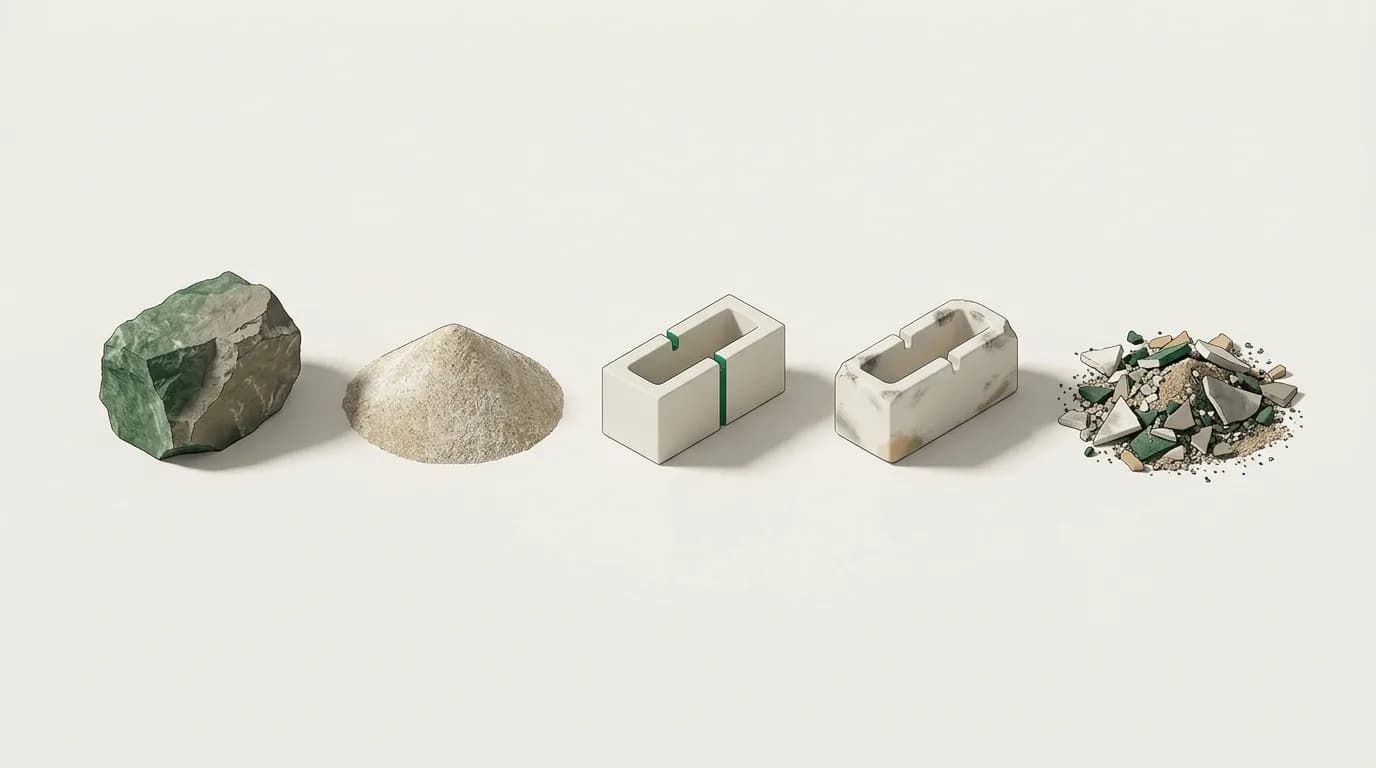
A product life cycle is the whole sequence of stages a product passes through, from extracting its raw material to disposing of it as waste. Think of it as an object’s biography: where it came from, how it was made, how it travelled, how long it was used, and what became of it.
The concept should not be confused with life cycle assessment (LCA). The product life cycle is the object — the thing being measured. LCA is the method — the standardised way of measuring it. It is also confused with the marketing sense of ‘product life cycle’ (introduction, growth, maturity, decline); that is a sales concept, while this is a physical flow of matter.
The five stages
1. Raw material supply
Mining, agriculture, forestry, or the collection of recovered material. Ore extraction and beneficiation for metals; harvesting for timber; oil refining and polymerisation for plastics all sit here. For most construction materials this stage carries the largest share of impact.
2. Manufacturing
Turning raw material into product at the plant: melting, firing, forming, assembly, packaging. The energy intensity of this stage varies widely by sector — the kiln dominates in ceramics, electrolysis in aluminium, the clinker kiln in cement.
3. Distribution
Transport from the plant to the point of use, and installation where relevant. For low-density or heavy products — glass, concrete, insulation — transport distance shifts the result noticeably; for small, high-value products it usually stays negligible.
4. Use
The period in which the product performs its function: energy and water consumption, maintenance, repair, component replacement. For energy-consuming products — appliances, motors, boilers — this stage is most of the total. For passive products, maintenance and replacement frequency decide it.
5. End of life
Deconstruction, collection, transport and final treatment: reuse, recycling, energy recovery or landfill. Where the material goes at this stage can change the whole result — especially for materials carrying biogenic carbon, such as timber, and those with high recycling value, such as metals.
Mapping to the EN 15804 modules
For construction products these five stages are reported under a standard module lettering. Knowing what each letter means is the precondition for reading the numbers in an EPD correctly.
- A1-A3 — product stage: raw materials, their transport, manufacturing. The minimum set most EPDs cover.
- A4-A5 — construction stage: transport to site, installation and installation waste
- B1-B7 — use stage: use, maintenance, repair, replacement, refurbishment, operational energy and water
- C1-C4 — end of life: deconstruction, transport, waste processing, disposal
- D — recovery potential beyond the system boundary; reported separately, never added to the total
System boundary: where to stop
A study need not cover every stage, but it must say plainly where it stopped. A cradle-to-gate calculation covers A1-A3 and is the natural choice for producers selling intermediate goods. Cradle-to-grave runs through the C modules and makes sense for final products. Cradle-to-cradle describes a closed system where recycling feeds a new cycle.
Frequently asked questions
- Are the product life cycle and LCA the same thing?
- No. The product life cycle is the object being measured — the physical stages a product passes through. LCA (life cycle assessment) is the method for measuring the environmental impact of those stages, standardised by ISO 14040/14044. One is the subject, the other the method.
- Is this related to the product life cycle curve in marketing?
- No. The marketing product life cycle describes a product’s sales trajectory in the market: introduction, growth, maturity, decline. What is described here is a physical flow of matter and energy. The two share a name and nothing else.
- Which stage creates the most impact?
- It depends on the product type, and it should be calculated rather than assumed. For construction materials most impact sits in A1-A3, in raw materials and manufacturing. For energy-consuming products the use stage (B6) dominates. For food it is agricultural production; for electronics, chip fabrication.
Tags
- product life cycle
- life cycle stages
- cradle to grave
- EN 15804
- system boundary
- fundamentals
Related reading
All articles in Fundamentals- Fundamentals
What is life cycle assessment (LCA)?
LCA is the standardised method for measuring a product’s environmental impact from raw material to waste. Its four phases, what it does and does not do, and where to start.
12 min read - Fundamentals
How is a product life cycle (LCA) calculated? In six steps
The whole flow from functional unit to result table. What data to collect, where to get it, and how quickly a first calculation can be finished.
12 min read - ISO Series
System boundary: cradle-to-gate, -grave, -cradle — which when?
System-boundary choice defines which life cycle modules your study includes. The three core scopes and selection criteria.
9 min read - Fundamentals
What is an EIA, and how does it differ from LCA?
The two most commonly confused concepts. One is a permitting process, the other a measurement method — and neither substitutes for the other.
9 min read