Insulation EPDs: EN 16783 for glass wool, stone wool and EPS
An insulation EPD follows the EN 16783 PCR: the declared unit is the quantity of 1 m² of product that provides 1 m²K/W of thermal resistance. Hotspots of glass wool, stone wool and EPS, the A1–A3 order of magnitude and verifier pitfalls.
By clca Editorial TeamLast updated
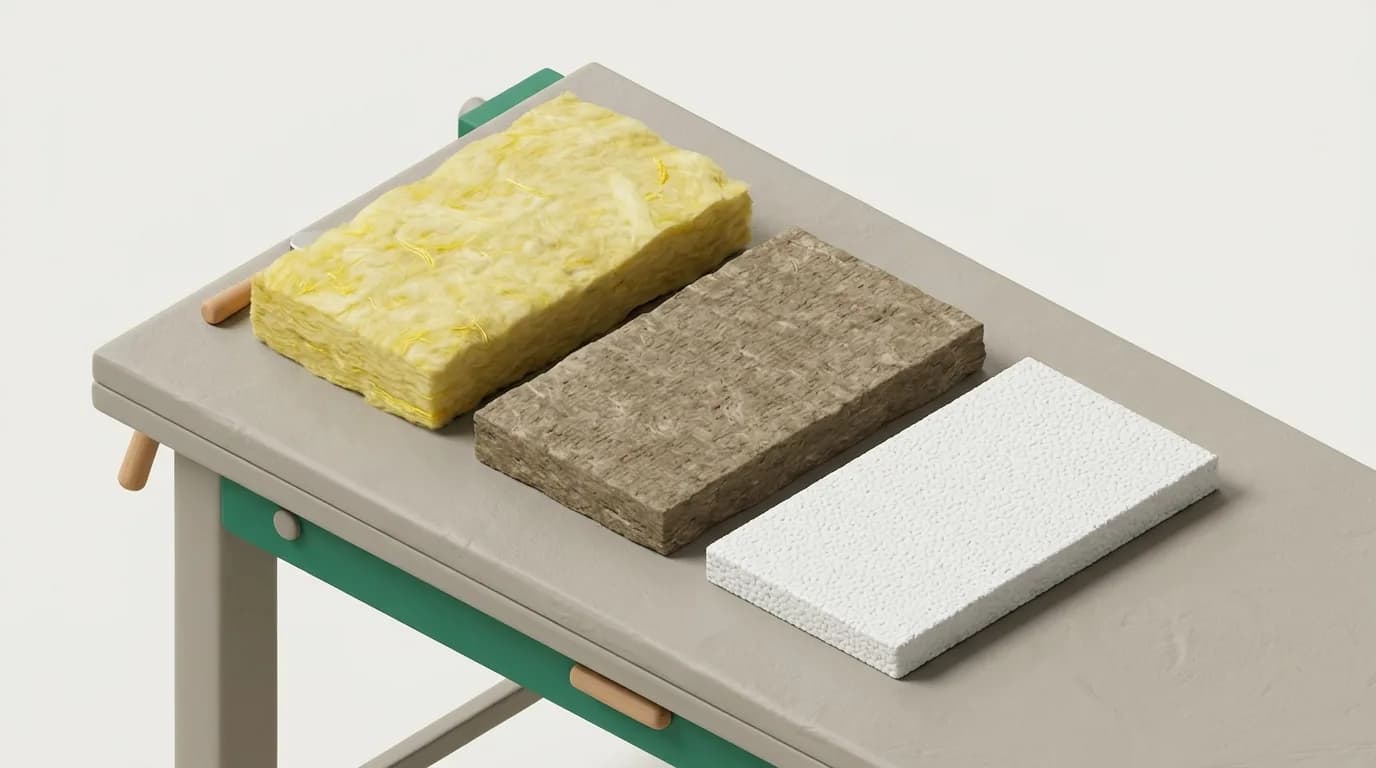
An insulation EPD is prepared by adding EN 16783, the complementary PCR written for thermal insulation products, to the core rules of EN 15804+A2, and it differs from other construction product EPDs in two respects. The first is the declared unit: results are given not per kilogram or cubic metre but per quantity of product that provides 1 m²K/W of thermal resistance (R) over 1 m², so materials of different density and conductivity are read on the same denominator. The second is that the carbon profiles of the three major product families (glass wool, stone wool, EPS) come from entirely different processes: the melting furnace and binder in glass wool, the cupola furnace and coke in stone wool, styrene monomer and blowing agent in EPS. This article covers the rules the PCR fixes when an insulation manufacturer prepares the EPD, where data collection should focus for each material, and the mistakes verifiers trip over most often.
The EN 16783 declared unit and thickness conversion
The rule at the heart of EN 16783 is that results are tied to thermal performance. The declared unit is the quantity of 1 m² of product that provides a thermal resistance of R = 1 m²K/W; that quantity is calculated from the product's declared thermal conductivity (λD): the required thickness d = R × λD. For a product with λD = 0.035 W/mK, the thickness corresponding to R = 1 m²K/W is 35 mm; at a density of 20 kg/m³ the mass per declared unit is 0.7 kg. For the same R, a product with λD = 0.032 needs only 32 mm and carries less mass. The PCR also allows 1 m² of product at a specified thickness to be used as the declared unit; because that option makes product comparison harder, most operators ask for the R-based declaration or expect both units to be given. The manufacturer presents both conversions in the EPD as a table: results per declared unit, plus scaling factors per kg and per m² × mm.
Glass wool: furnace energy and binder
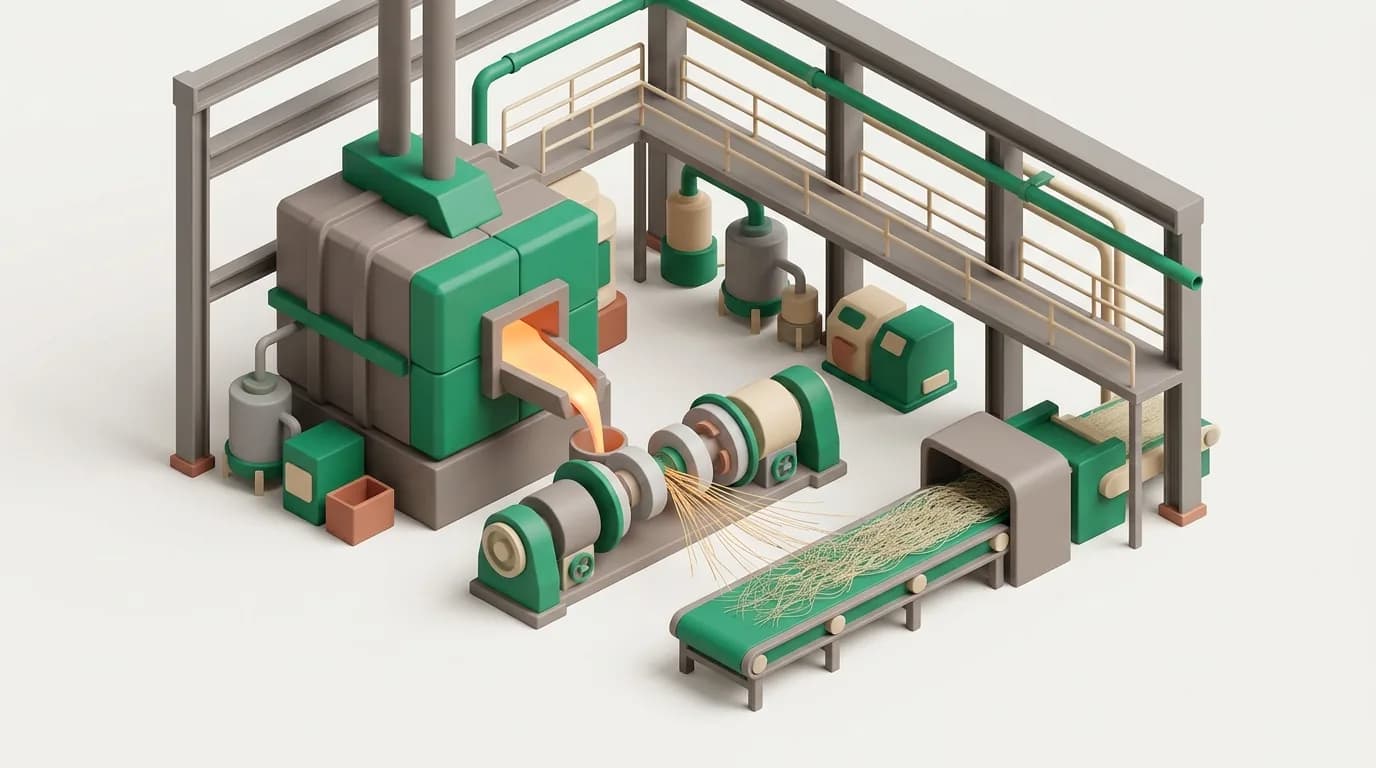
In a glass wool EPD, the decisive A1–A3 items are the energy of the glass melting furnace and the organic binder. On the raw material side sand, soda ash, dolomite and usually a high share of recovered glass (cullet) are used; as the cullet share rises, both raw material emissions and furnace energy fall, and that share is a production parameter that must be documented in the EPD. The furnace runs on natural gas or electricity (or a hybrid); in an electric furnace the choice of electricity factor carries the result directly. The binder applied after fiberising is a small percentage of product mass, yet the choice between phenol-formaldehyde and bio-based resin makes a difference in GWP and in the toxicity indicators; curing oven energy is added to A3 as well. Typical glass wool products publish an A1–A3 GWP of roughly 1–2 kg CO₂e per kg; per declared unit (R = 1 m²K/W) that corresponds to roughly 0.7–1.5 kg CO₂e depending on density. Values vary between published EPDs with plant, cullet share and energy source.
Stone wool: cupola furnace and coke
In a stone wool EPD, the hotspot is the coke burned in the cupola furnace where basalt and diabase are melted; coke enters as both fuel and reducing agent and alone explains most of A1–A3. Manufacturers reduce that share through electric melting, feeding briquetted production waste back into the furnace and heat recovery from furnace gas; those investments show directly in the EPD, which is why EPDs of the same product family from different plants diverge markedly. Stone wool products are denser than glass wool (often 30–100 kg/m³ for slabs), so mass and GWP per declared unit are higher; GWP per kg is typically around 1–1.5 kg CO₂e/kg, while the value per declared unit reaches roughly 1–4 kg CO₂e depending on product density. Additional functions such as fire performance and acoustic insulation do not appear in the same declared unit; EN 16783 allows them to be declared as additional technical information but keeps them out of the results table.
EPS: styrene, pentane and expansion
In an EPS EPD, the weight of A1 lies in the raw material, expandable polystyrene bead; the petrochemical chain of styrene monomer pushes GWP per kg above that of mineral wools (typically around 3–4 kg CO₂e/kg). But EPS is very light (15–30 kg/m³), so the result per declared unit comes down to the same order of magnitude as the mineral wools, roughly 1–2 kg CO₂e; that is why mass-based comparison penalises EPS unfairly. In A3 the main energy input is steam for pre-expansion and block moulding; the boiler fuel is documented in the EPD. Part of the pentane blowing agent is released to air during production and storage; pentane is not a greenhouse gas, but it raises the photochemical ozone formation (POCP) indicator markedly, and the verifier asks whether that emission is in the inventory. Recycled EPS content (production offcuts and post-consumer) lowers A1; the content share and its source are stated in the EPD.
End-of-life scenarios and Module D
For insulation products, end of life is declared with scenarios that differ by material family, and EN 16783 requires the assumptions of those scenarios to be written in the EPD. For glass wool and stone wool, the realistic baseline scenario is still largely landfill; remelting of removed product is technically possible and some manufacturers run take-back schemes, but in the baseline the recovery rate must be justified with national data. For EPS the baseline is usually incineration with energy recovery; because its net calorific value is high, the credit for substituted energy is calculated in Module D and shown separately. Packaging (EPS block film, mineral wool pallets) is declared in A5; for installation cutting waste the PCR's minimum waste rate applies. Because all these scenarios are read module by module in a building LCA (EN 15978), they are given in the EPD broken out per module and not added into the totals.
The mistakes verifiers trip over most often
The reason an insulation EPD is rejected is rarely a calculation error; most of the time it is incomplete documentation of the declared unit or a scenario.
- λD not matching the product declaration (CE marking, DoP) — the declared unit thickness comes out wrong
- Calculating with a single density for a product family with a wide density range and declaring it as if it covered the family
- Process parameters such as cullet share, coke consumption or pentane release left undocumented
- Using a market-based electricity factor without presenting the supply certificate
- Assuming A5 installation waste below the PCR minimum
- Taking an optimistic end-of-life recovery rate without national data; adding Module D into the totals
- Trying to base the results table on functions such as fire or acoustic class
Insulation EPDs in green building credits
Insulation is a small item by mass in a building LCA but central in function, and certification schemes use insulation EPDs in two ways. In LEED and BREEAM, a product-specific EPD counts towards the number of documents earning points in the materials credits; in frameworks such as DGNB and Level(s), EPD data is transferred directly into the building-level LCA, and an R-based declared unit makes that transfer easier: the designer knows the R needed for the target U-value and scales the EPD result directly. That is why tender specifications increasingly carry the wording 'third-party verified EPD prepared under EN 15804+A2 and EN 16783' for insulation. Industry-average EPDs satisfy that requirement, but a product-specific EPD turns a low-carbon plant's advantage into points.
Frequently asked questions
- What is the declared unit in an insulation EPD?
- Under EN 16783 it is the quantity of product providing R = 1 m²K/W of thermal resistance over 1 m²; the thickness follows from d = R × λD. For λD = 0.035 W/mK it is 35 mm. The PCR also accepts 1 m² of product at a specified thickness, but most operators ask for the R-based declaration.
- Which of glass wool, stone wool and EPS has the lower EPD GWP?
- Per declared unit all three publish roughly 1–4 kg CO₂e, and the ranking varies by plant. Per kg EPS is highest (roughly 3–4 kg CO₂e/kg), but being the lightest it lands in the same order of magnitude as the mineral wools in the R-based result. Comparison is valid only under the same declared unit and the same PCR.
- Which process parameters must be documented in an insulation EPD?
- For glass wool the cullet share, furnace fuel and binder type; for stone wool coke consumption and furnace gas heat recovery; for EPS the bead source, boiler fuel for steam and pentane release. For all of them λD, the density range, the source of the electricity factor and the A5 waste rate.
- Is B6 energy saving declared in an insulation EPD?
- It does not enter the results table. EN 16783 allows use-stage heating savings to be declared as additional information under specified climate, building type and energy mix assumptions; that information is not added to the A1–A3 results and cannot serve as a basis for comparison.
- How is an insulation EPD used in green building certification?
- In LEED and BREEAM a product-specific, third-party verified EPD counts in the materials credits; in frameworks such as DGNB and Level(s) the EPD data is transferred directly into the building LCA. The R-based declared unit makes scaling to the thickness required for the target U-value straightforward.
Related reading
All articles in Sectors- Sectors
Aggregate EPDs: quarry, crushing-screening energy and transport
Aggregate is one of the lowest-carbon construction materials per tonne, yet its volume makes it visible in a building's balance. An aggregate EPD is prepared with a 1 tonne declared unit; diesel, electricity and transport distance set the result.
11 min read - Sectors
Preparing a concrete EPD: EN 16757 PCR and mix design data
A concrete EPD is prepared under EN 15804+A2 with the complementary PCR EN 16757: a 1 m³ declared unit, a mix per strength class, the cement EPD as an input, B1 carbonation and C/D scenarios.
10 min read - Sectors
Insulation product LCA: U-value, lambda, RC and the functional unit
Insulation LCA must tie the functional unit to thermal performance. The relationship between λ, RC, U-value and the B6 benefit debate.
11 min read - Sectors
Timber LCA: biogenic carbon storage, sustainable forestry and end-of-life
The claim that timber is 'carbon negative' has to survive proper accounting. When stored carbon may be counted, and what happens at end-of-life.
11 min read