How to obtain an EPD: process, timeline and cost items
An EPD is obtained in six steps: PCR selection, data collection, LCA model, EPD document, independent verification and publication by a programme operator. Typically 6–14 weeks; the cost has four components.
By clca Editorial TeamLast updated
An EPD is a document that declares a product's life cycle environmental performance under the rules of ISO 14025 and EN 15804+A2, verified by an independent third party and published by a programme operator. Obtaining one takes six steps: selecting the applicable PCR, collecting site data, building the LCA model, writing the EPD document, independent verification and publication with a programme operator. The step that sets the timeline is almost always data collection; verification and publication follow the operator's calendar and are comparatively predictable. This article walks through the steps, typical durations and cost items a manufacturer meets when obtaining a first EPD.
Who issues an EPD?
The body that issues an EPD is the programme operator; the verifier is an independent expert approved by that operator. They cannot be the same person. A programme operator runs an EPD programme under ISO 14025: it publishes general programme instructions (GPI), manages PCRs, accredits verifiers and publishes verified EPDs in its own registry. In Europe, operators such as EPD International, IBU, ITB and ECOnsult are common; all build on EN 15804+A2 and carry mutual recognition under the ECO Platform umbrella. The verifier audits the LCA report and the EPD document against the PCR and the standard; it may contract with the manufacturer directly or be assigned by the operator. The manufacturer owns the data and is responsible for the declaration: it must be able to document the source of every figure in the EPD.
The EPD process in six steps
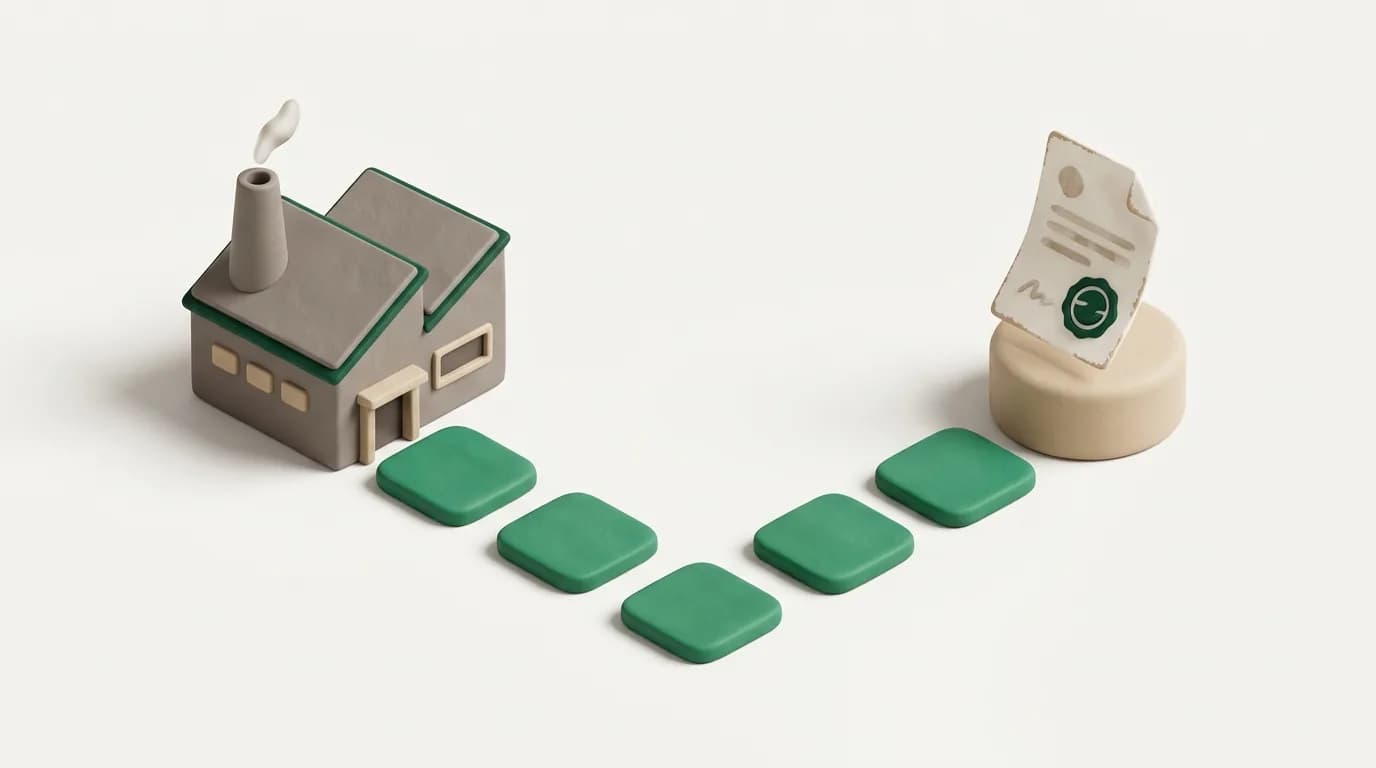
The process is linear, but loops between steps are normal; the most frequent loop is the verifier sending the manufacturer back to step two with a data quality question.
- 1. PCR selection — the product category rule applicable to the product is identified (the EN 15804+A2 core PCR plus a complementary PCR where one exists, such as EN 16757 for concrete or EN 16783 for insulation). The declared unit and module coverage are fixed here.
- 2. Data collection — for a 12-month production period, raw material consumption, energy, water, waste, packaging, transport distances and production volume are taken from the plant; supplier EPDs are gathered.
- 3. LCA model — the inventory is matched to a background database (such as ecoinvent); the EN 15804+A2 indicator set is calculated; data quality is scored; the LCA background report is written.
- 4. EPD document — the declaration is drafted in the operator's template: product description, declared unit, system boundary, scenarios, results tables, additional environmental information.
- 5. Independent verification — the verifier reviews the LCA report and the EPD, sends a question list, requests corrections and signs the verification statement.
- 6. Publication — the operator assigns a registration number and validity date and publishes the EPD in its registry and in digital formats (such as ILCD+EPD).
Timeline: data readiness sets the calendar
The typical total for a first EPD is 6–14 weeks; the lower end is reached only when the data is ready from the start. Data collection can take from one week to two months depending on how orderly the plant's accounting and production records are. LCA modelling and the EPD document are completed within 1–3 weeks after the data is complete; with software support this drops to days. Verification takes 2–8 weeks depending on the operator and the verifier's workload; operators such as ITB are known to be faster, operators such as IBU slower. Publication usually follows within 1–2 weeks of the signed verification statement. The most effective way to shorten the calendar is to read the PCR at the start and build the data collection form around the fields the PCR demands: most verifier questions concern a data point the PCR explicitly requires but that was never collected.
Cost items
The cost of an EPD is not a single invoice but four separate items, and the largest is often the invisible internal effort. The first item is the LCA study: commissioned from a consultant it is the largest external item, scaled by product complexity; done in-house with software it becomes a licence fee plus team time. The second is the verification fee: the verifier's hourly or fixed charge varies with the number of products and module coverage, and is a mid-sized item for a single-product EPD. The third is programme operator fees: a registration fee plus an annual publication fee, or with some operators a lump sum for five years. The fourth is internal effort: the time of the production and accounting teams that gather data. Grouping several products into one EPD (a product family), or deriving several EPDs from one model, sharply reduces the verification and operator items per product.
Required documents and data
The set of documents a verifier asks for varies with the PCR, but the core list below applies to almost every EN 15804+A2 EPD.
- Product technical data sheet and composition list (percentage by mass; confidential formulations are disclosed to the verifier under NDA)
- 12-month production volume and, for the same period, consumption records for raw materials, energy, water and auxiliaries
- Electricity bills and, where relevant, renewable supply certificates (mandatory if a market-based factor is used)
- Waste declarations: waste type, quantity and disposal or recovery route
- Supplier EPDs or supplier-specific data; otherwise a justification for the background dataset used
- Transport data: vehicle type, distance and load factor for inbound materials and outbound product
- Packaging composition and quantity; sources for installation, use and end-of-life scenario assumptions
- The LCA background report (in ISO 14044 structure) and the data quality assessment
Validity and what comes after
A published EPD is valid for five years from its issue date under EN 15804+A2; within that period the declaration is updated earlier if product composition, production process or energy source changes the results significantly. When it expires, the EPD shows as invalid in the operator's registry; green building certification schemes and public tenders do not accept an expired EPD. Obtaining a first EPD therefore starts a five-year maintenance cycle: a manufacturer that refreshes its inventory annually can almost skip data collection at renewal time and reduce the process to verification and publication. The same model can also be re-issued in different formats for different operators; that requires a second verification for new markets, but not a new LCA.
Choosing an operator and verifier as a manufacturer in Turkey
A company manufacturing in Turkey publishes its EPD with an international programme operator, chosen according to the target market. IBU is the typical choice for Germany and DGNB projects, EPD International for Scandinavia and international tenders, ITB or ECOnsult where fast turnaround and budget come first. Two practical criteria govern the verifier choice: accreditation with the selected operator and prior experience in the product category. Local LCA consultants and verifiers who communicate in Turkish and work with ecoinvent and EN 15804+A2 shorten the timeline because they can work with the plant directly during data collection. The clca marketplace lists consultant and verifier profiles by category and operator accreditation, cutting the step that costs the most time in a first EPD: finding the right expert.
Frequently asked questions
- How long does it take to obtain an EPD?
- A first EPD typically takes 6–14 weeks in total. Data collection takes 1–8 weeks, LCA modelling and the EPD document 1–3 weeks, independent verification 2–8 weeks and publication 1–2 weeks. The variable that sets the timeline is whether plant data is ready; reading the PCR first and building the data form around it is the step that shortens the calendar most.
- What makes up the cost of an EPD?
- There are four items: the LCA study (consultant fee, or software licence plus team time), the independent verification fee, the programme operator's registration and annual publication fee, and the internal effort of the teams that gather data. Grouping several products into one EPD, or deriving several EPDs from one model, lowers the verification and operator items per product.
- Who issues the EPD, and are the verifier and operator the same?
- No. The programme operator publishes the EPD; verification is done by an independent verifier accredited by that operator. ISO 14025 requires the two roles to be separate. The manufacturer owns the data and is responsible for the declaration; the LCA may be prepared by its own team or by a consultant.
- How many years is an EPD valid?
- Five years from the issue date under EN 15804+A2. The declaration is updated earlier if product composition, production process or energy source changes the results significantly. An expired EPD is not accepted in green building certification or public tenders.
- Where is an EPD published for a product manufactured in Turkey?
- With an international programme operator, chosen according to the target market. IBU for Germany and DGNB, EPD International for Scandinavia and international tenders, ITB or ECOnsult for fast turnaround are the common choices. All build on EN 15804+A2 and carry mutual recognition under ECO Platform.
Tags
- EPD
- EN 15804
- PCR
- EPD verifier
- verification
- how to obtain an EPD
- EPD cost
- EPD timeline
Related reading
All articles in Verification- Verification
EPD validity: the five-year rule and what triggers an update
An EPD is valid for five years from its issue date; it is updated earlier if product, process or energy source changes the results significantly. What happens when an EPD expires, which changes call for re-verification and how to plan the five-year maintenance cycle.
10 min read - Verification
How to read an EPD: a guide for procurement and design teams
An EPD is read in five steps: the cover data, the declared unit, the module scope, the GWP rows and the comparability conditions. Red flags, and moving EPD data into a building LCA.
10 min read - Verification
Industry-average EPD or product-specific EPD?
There are three EPD types: product-specific, manufacturer average and industry average. Representativeness, the credit difference in green building schemes, tender expectations, cost and the strategy for moving from an average to a product-specific declaration.
10 min read - Verification
How is an Environmental Product Declaration (EPD) calculated?
The calculation behind an EPD is an LCA, but not a free one: the PCR dictates what you calculate and how. The flow from rule set to result table.
12 min read