Aggregate EPDs: quarry, crushing-screening energy and transport
Aggregate is one of the lowest-carbon construction materials per tonne, yet its volume makes it visible in a building's balance. An aggregate EPD is prepared with a 1 tonne declared unit; diesel, electricity and transport distance set the result.
By clca Editorial TeamLast updated
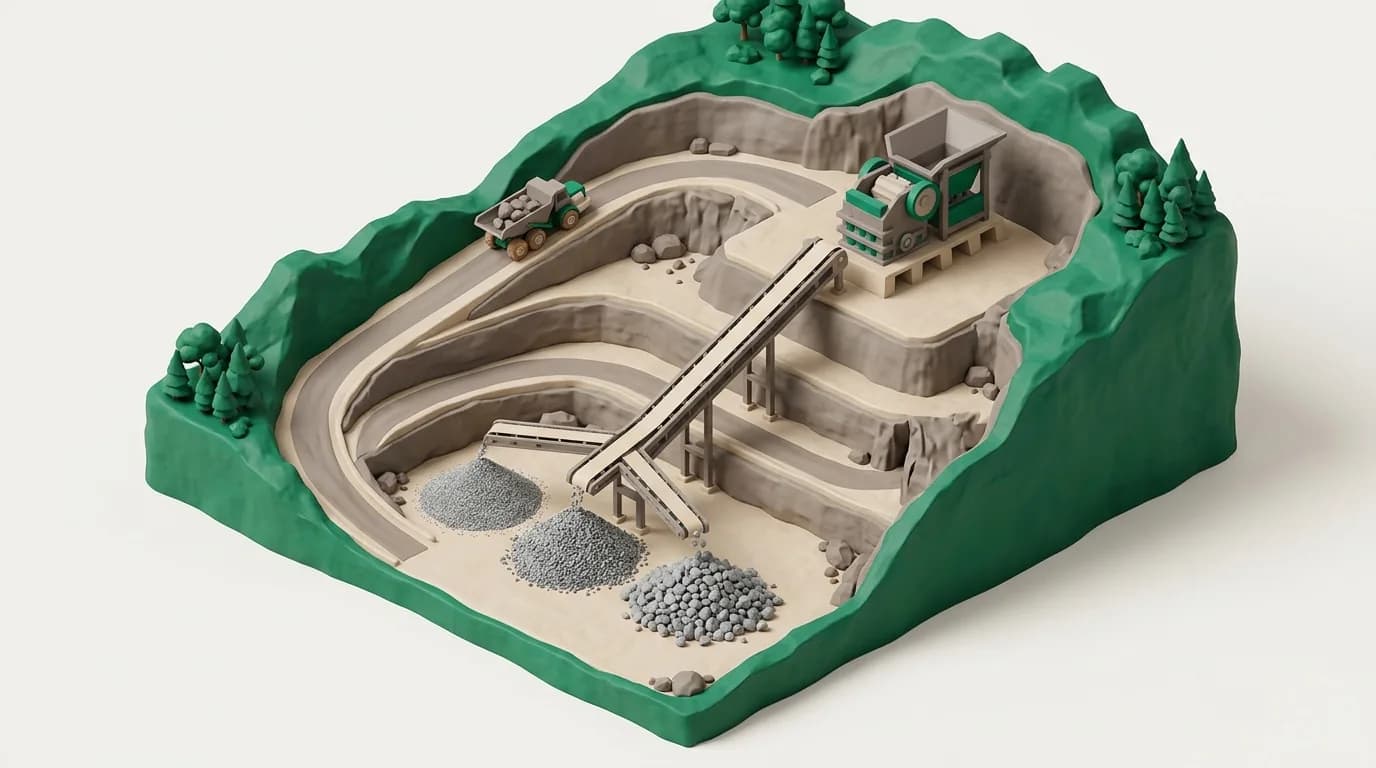
An aggregate EPD declares the environmental performance of natural or recycled aggregates such as sand, gravel and crushed rock under EN 15804+A2, with a declared unit of 1 tonne. The A1–A3 global warming potential of aggregate is typically in the order of a few kilograms of CO₂e per tonne, roughly a thousandth of cement or steel. Even so, aggregate EPDs have gained importance for two reasons: because aggregate makes up 70–85% of concrete and asphalt by mass, it is a direct input to concrete EPDs, and in a building LCA its volume makes it a visible item in the total. Three things determine the result of an aggregate EPD: diesel consumption at the quarry, electricity of the crushing and screening line, and the distance over which the product is hauled to site. This article explains where a quarry operator collects data when preparing the EPD, which scenarios carry the result, and how Module D is handled for recycled aggregate.
Why low unit impact but high total?
Aggregate is among the product groups with the lowest environmental impact per unit mass within construction materials because it involves no chemical transformation: rock is crushed, screened, washed and hauled; there is no calcination, melting or polymerisation. In published EPDs, A1–A3 GWP values for natural crushed rock and gravel generally fall in the range of roughly 2–10 kg CO₂e per tonne; quarry type, rock hardness, washing need and electricity source decide the position within that range. Its visibility in the total comes from volume: a cubic metre of typical structural concrete contains 1.8–1.9 tonnes of aggregate, and thousands of tonnes are hauled for one building. In a concrete EPD, aggregate's share of A1–A3 is small, but once transport is added it becomes noticeable; that is why concrete producers increasingly ask to use the supplier's aggregate EPD as an input in their own.
PCR and declared unit: 1 tonne
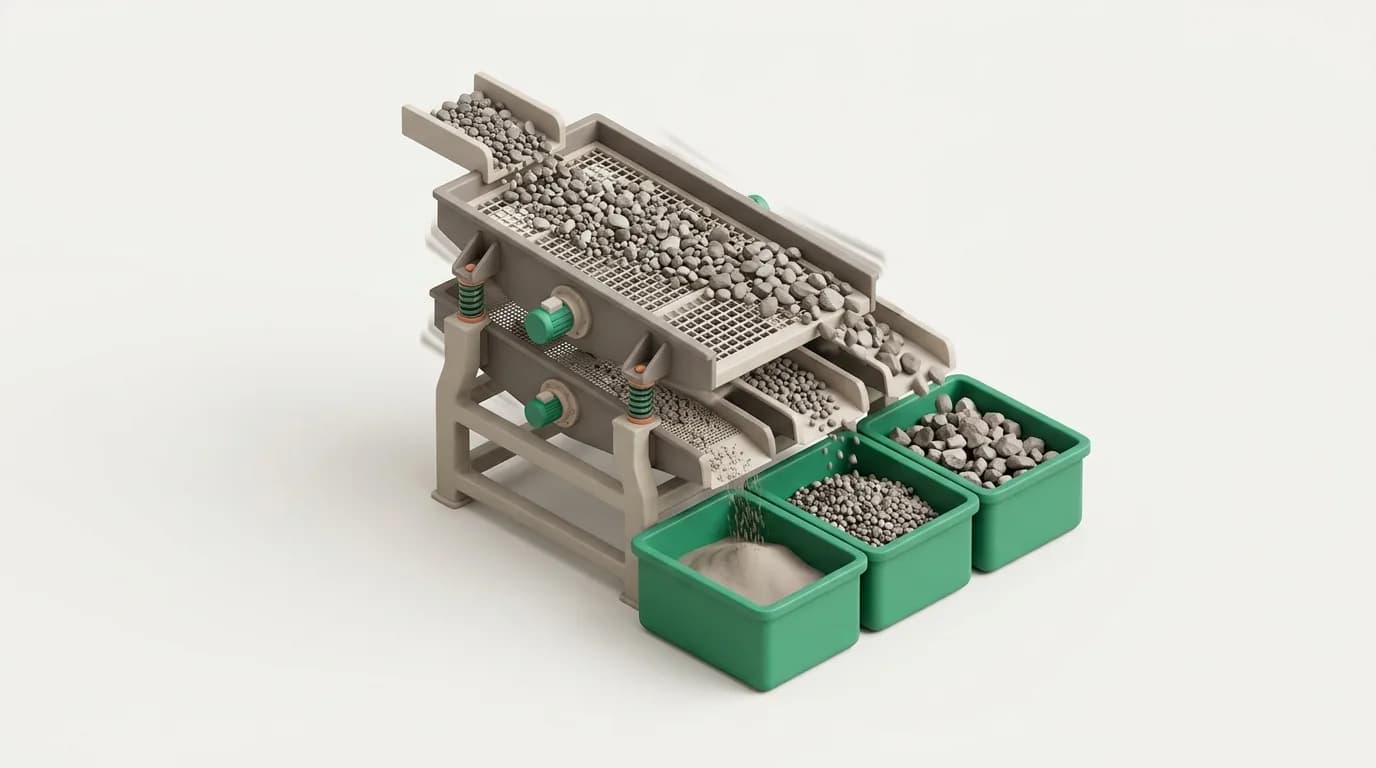
There is no separate European complementary PCR for aggregates; the EPD follows the EN 15804+A2 core PCR and, where they exist, the sub-rules the chosen programme operator publishes for aggregates and mineral products. The declared unit is 1 tonne of aggregate; the product is defined by fraction (0/4 sand, 4/16 gravel, 16/32 crushed rock and so on), rock type and application (concrete aggregate, asphalt aggregate, fill). It is common for different fractions from the same quarry to be declared together in one EPD; crushing and screening energy is allocated to fractions by production mass or by number of screen passes, and that allocation rule is written in the EPD. Module coverage is at least A1–A3; because end of life and Module D are handled in the concrete EPD when aggregate is used in concrete, cradle-to-gate coverage is considered sufficient in most aggregate EPDs, though depending on the operator scenarios may be requested for A4 and the C modules.
Process steps and data points
The quarry inventory is built by dividing the 12-month total consumption of four process steps by the tonnes produced. The list below is the backbone of the data collection form.
- Drilling and blasting: drill rig fuel (diesel), explosive type and kg/tonne — the explosive itself is a small but not negligible A1 item
- Loading and internal haulage: diesel consumption of excavators, loaders and in-pit trucks; usually the largest diesel item in A1–A3
- Crushing and screening: electricity of primary, secondary and tertiary crushers and screens, including belt conveyor motors
- Washing and dewatering: water consumption, share of recovered wash water, flocculant use and sludge quantity
- Auxiliaries: wear parts (steel liners, screen mesh), lubricants, stockyard lighting
- Product and waste: sales tonnage by fraction, unsaleable fines (rock dust) and their fate
- Electricity factor: location-based grid or documented supply contract
Diesel or electricity? The share that carries the result
In an aggregate EPD, the composition of A1–A3 swings between two poles depending on how much of the quarry runs on diesel and how much on electricity. In a conventional quarry, loading and internal haulage diesel usually explains more than half of total GWP and crushing-screening electricity most of the rest; explosives and auxiliaries stay small. In countries with a carbon-intensive grid the crushing-screening share grows; in quarries with a renewable supply contract or on-site solar the same line drops to almost zero. In quarries using mobile crushers, crushing also runs on diesel, so the electricity item disappears but the total usually rises. That composition also shows where the reduction decision belongs: taking internal haulage off diesel with electric excavators and belt conveyors is, in most quarries, the single investment that lowers the EPD result most. The verifier asks whether diesel consumption is quarry-wide and allocated only to the products within the EPD's scope, for example whether unsaleable rock dust counts as product or waste.
Recycled aggregate and Module D
Recycled aggregate produced from construction and demolition waste is, under EN 15804+A2, a secondary material whose input arrives burden-free under the cut-off rule; the burden of crushing, screening and sorting is written to the A1–A3 of the recycled aggregate. A recycled aggregate EPD may therefore show A1–A3 in the same order of magnitude as natural aggregate, and sometimes higher; its environmental benefit comes from the quarry burden of the natural aggregate it replaces and from avoided landfill, and that benefit sits outside the system boundary. EN 15804+A2 allows Module D to be calculated in the recycled aggregate's own EPD only when the product is recovered again at its end of life (the second loop); the benefit of the first loop has already been counted as Module D in the EPD of the building or concrete product that produced it. Counting the same benefit in two EPDs is double counting, and the verifier rejects it. In a natural aggregate EPD the typical scenario for the C modules is the aggregate being crushed within concrete and reused as aggregate at 70–90%; the Module D credit is as large as the A1–A3 of the natural aggregate substituted, that is, low, and it is shown on a separate line.
When transport exceeds A1–A3
Aggregate is one of the rare construction materials where transport overtakes production, which is why the A4 scenario in the EPD demands particular attention. For road haulage the emission per tonne-kilometre varies with vehicle class and load factor; in ecoinvent 3.12 it is in the order of 0.1 kg CO₂e/tkm for a 16–32 tonne EURO 6 lorry. Once the quarry-to-site distance reaches 30–50 km, the A4 emission alone approaches or exceeds the A1–A3 total; at 100 km it can be twice A1–A3. That makes it essential to write the A4 scenario, with its distance, vehicle and load assumptions, next to the EPD's cradle-to-gate result, and explains why 'local sourcing' of aggregate is a reduction strategy in a building LCA. For aggregate carried by sea or rail the emission per tkm is far lower; the final lorry leg from port or station to site still enters the calculation. Empty return is included in the load factor: if the lorry travels loaded one way and returns empty, the tonne-kilometre factor is chosen accordingly.
The aggregate EPD as an input to the concrete EPD
The most concrete use of an aggregate EPD is as supplier data in the concrete producer's own EPD. For aggregate in a concrete EPD there are three options: the quarry's verified EN 15804+A2 EPD, primary data obtained from the quarry, or the regional crushed rock or gravel activity in a background database such as ecoinvent. The quarry EPD reflects the actual diesel-electricity composition and washing practice, so verifiers prefer it and it raises the data quality score of the concrete EPD. For that, the aggregate EPD must be prepared under the same standard revision (A2), be valid and give results per fraction; the concrete producer scales the EPD results by the kg/m³ of each fraction in its mix and calculates quarry-to-plant transport separately in its own A2 module. This chain also shows why an aggregate EPD can settle for cradle-to-gate coverage: A4 and beyond are completed in the concrete EPD, and the concrete's in the building LCA.
Frequently asked questions
- What is the declared unit in an aggregate EPD?
- It is 1 tonne of aggregate; the product is defined by fraction (0/4, 4/16, 16/32 and so on), rock type and application. Different fractions from the same quarry can be presented as separate declarations in one EPD; the rule allocating crushing-screening energy to fractions is written in the EPD.
- What is the carbon footprint of aggregate per tonne?
- In published EPDs, A1–A3 GWP for natural crushed rock and gravel is typically in the range of roughly 2–10 kg CO₂e per tonne; the diesel-electricity composition, washing and electricity source decide the position within the range. Once transport is added, at 30–50 km the A4 module alone approaches or exceeds A1–A3.
- Which is the largest emission item in an aggregate EPD?
- In a conventional quarry, loading and internal haulage diesel usually explains more than half of total GWP and crushing-screening electricity most of the rest. Explosives and auxiliaries are small. On carbon-intensive grids the electricity share grows; electric excavators and belt conveyors are the most effective reduction investment.
- How is Module D handled in a recycled aggregate EPD?
- The input arrives burden-free under the cut-off rule; the crushing and sorting burden is written to A1–A3. Because the benefit of the first loop has already been counted as Module D in the EPD of the building or concrete product that generated the waste, it cannot be counted again in the recycled aggregate's EPD; Module D is calculated only when the product is recovered a second time.
- Can a supplier's aggregate EPD be used in a concrete EPD?
- Yes, and verifiers prefer it. The aggregate EPD must be prepared under EN 15804+A2, be valid and give results per fraction; the concrete producer scales the results by the kg/m³ in the mix and calculates quarry-to-plant transport separately in its own A2 module.
Tags
- aggregate EPD
- EPD
- EN 15804
- PCR
- construction product EPD
- recycled aggregate
- Module D
- crushing and screening
Related reading
All articles in Sectors- Sectors
Preparing a concrete EPD: EN 16757 PCR and mix design data
A concrete EPD is prepared under EN 15804+A2 with the complementary PCR EN 16757: a 1 m³ declared unit, a mix per strength class, the cement EPD as an input, B1 carbonation and C/D scenarios.
10 min read - Sectors
Insulation EPDs: EN 16783 for glass wool, stone wool and EPS
An insulation EPD follows the EN 16783 PCR: the declared unit is the quantity of 1 m² of product that provides 1 m²K/W of thermal resistance. Hotspots of glass wool, stone wool and EPS, the A1–A3 order of magnitude and verifier pitfalls.
11 min read - Sectors
Ceramics LCA: firing energy, thickness and heat recovery
One line decides ceramic impact: the kiln. What glazing, drying and thin-body technology actually do to the total.
10 min read - Sectors
Timber LCA: biogenic carbon storage, sustainable forestry and end-of-life
The claim that timber is 'carbon negative' has to survive proper accounting. When stored carbon may be counted, and what happens at end-of-life.
11 min read