Preparing a concrete EPD: EN 16757 PCR and mix design data
A concrete EPD is prepared under EN 15804+A2 with the complementary PCR EN 16757: a 1 m³ declared unit, a mix per strength class, the cement EPD as an input, B1 carbonation and C/D scenarios.
By clca Editorial TeamLast updated
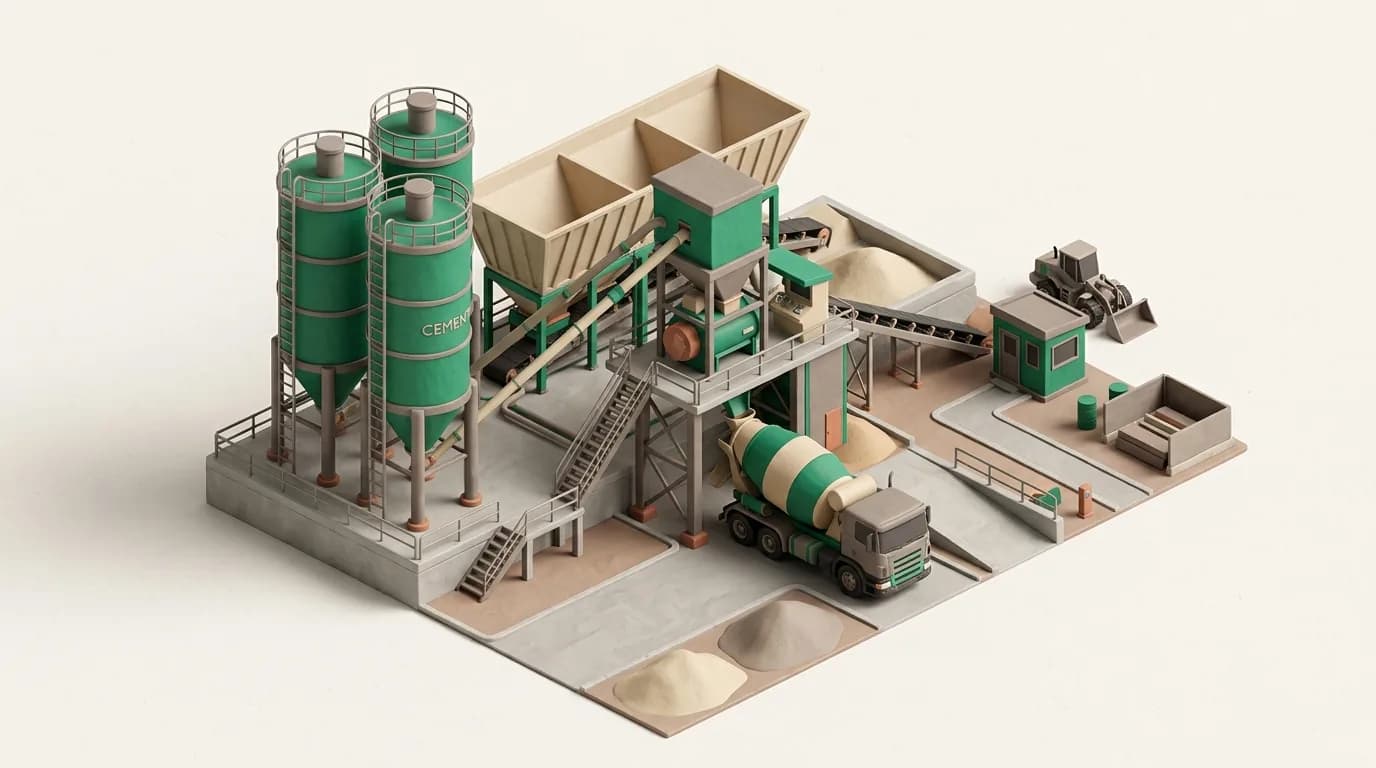
A concrete EPD is prepared by applying EN 16757, the complementary PCR written for concrete and concrete elements, on top of the core rules of EN 15804+A2. The declared unit is 1 m³ of concrete; the result belongs to a mix with a stated strength class and exposure class, and because more than three quarters of the mix's GWP comes from cement, the quality of the cement data sets the quality of the EPD. For a ready-mix plant or precast manufacturer the process has four blocks: the rules EN 16757 fixes, the collection of plant and mix data, the matching of cement and aggregate inputs to EPDs or background data, then verification. This article does not explain how to build a concrete LCA; it explains how a verifiable EPD document is produced from that LCA.
What does EN 16757 fix?
EN 16757 closes most of the decisions that could otherwise be left open in a concrete EPD; the manufacturer's room for decision shrinks to mix and scenario data. The declared unit is 1 m³ of concrete (for concrete elements it may be 1 m² or one piece depending on the product); each declaration is defined by strength class (C25/30, C30/37 and so on per EN 206), exposure class and, where relevant, consistence class. Module coverage is at least A1–A3; for concrete elements the A4–A5 and end-of-life modules (C1–C4, D) are declared too, and for ready-mix most operators expect cradle-to-grave coverage. The PCR also defines how carbonation is handled: CO₂ uptake during the use stage (B1) and at end of life (crushed concrete after C3/C4) may be reported using the calculation method in the standard, with the assumptions documented. Beyond that, the PCR's cut-off rules and default scenarios for packaging, production waste and water consumption apply as written.
Data collection: plant and mix
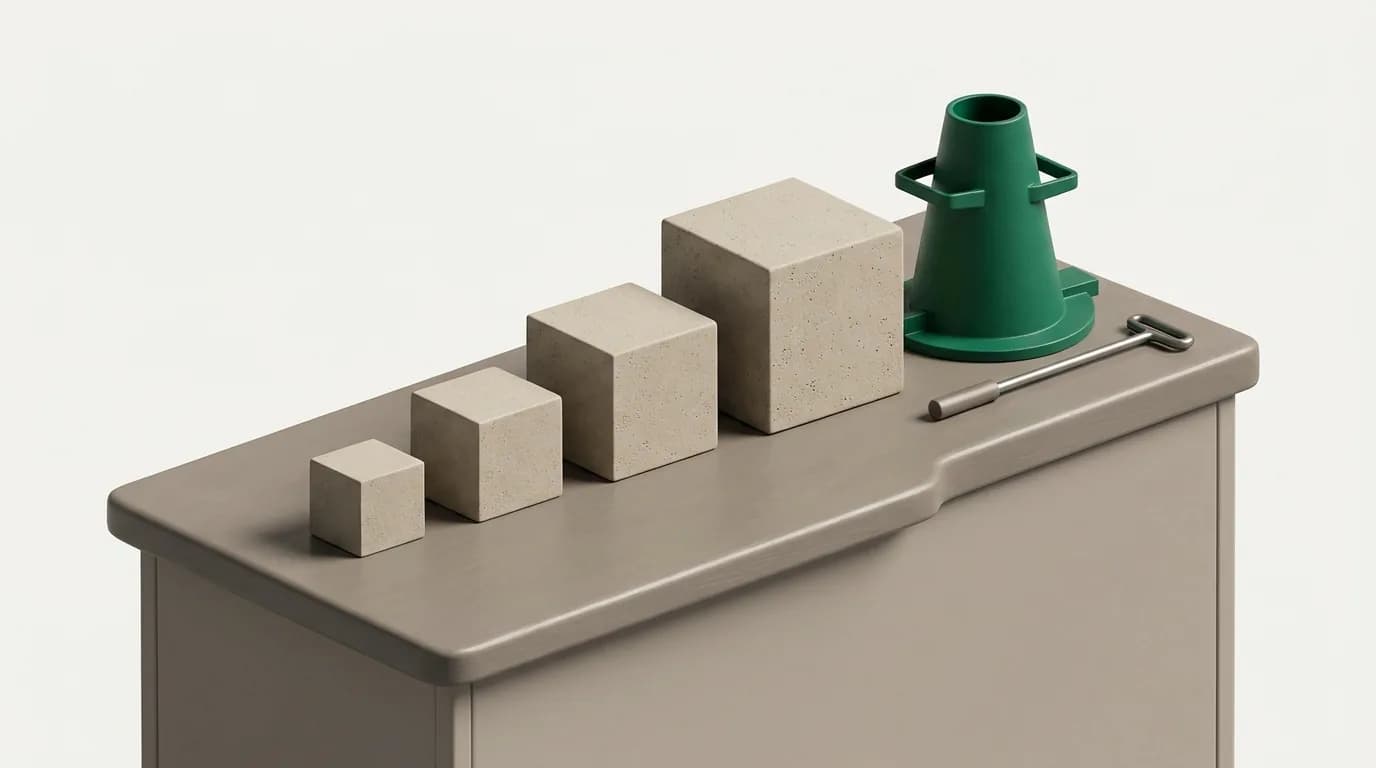
Data for a concrete EPD is collected in two layers: the mix layer and the plant layer. The mix layer holds, per 1 m³, cement type and quantity (kg/m³), aggregate fractions, mixing water, chemical admixtures and any mineral additions (slag, fly ash, limestone filler), together with their suppliers. The plant layer holds site-wide flows for a 12-month production period: total concrete output, electricity and fuel consumption, mixer and pump fuel, wash water and recovered wash water, production waste and returned concrete; these are allocated per m³ produced. For ready-mix, the average plant-to-site distance and vehicle type (truck mixer) are recorded for A4; for precast, formwork, curing energy and reinforcement are collected separately.
- Mix: cement type (CEM I, CEM II/A-M, CEM III/A and so on) and kg/m³; the actual production average from batching records, not the design mix
- Aggregates: kg/m³ by fraction, source quarry and distance to plant; share of recycled aggregate if any
- Admixtures: superplasticiser, air entrainer, set regulator — kg/m³ and the supplier safety data sheet
- Plant energy: kWh/year electricity, litres/year diesel (loader, mixer, boiler); divided by m³ produced
- Water: mains water, well water and recovered wash water recorded separately
- Waste and returns: returned concrete share and its fate, settling sludge quantity
- A4 data: average delivery distance, truck mixer capacity, loaded/empty return ratio
Cement data: supplier EPD or background dataset?
The biggest lever in a concrete EPD is the source of the cement input, because roughly 75–90% of the A1–A3 GWP of a typical structural concrete comes from cement. There are three options. The first is to use the cement supplier's own verified EPD as an input; EN 15804+A2 permits this and verifiers prefer it, provided the EPD is valid, prepared under the same standard revision (A2) and the declared cement type matches the one in the mix. The second is to obtain primary data from the supplier; large cement producers usually answer this with an EPD. The third is to select the appropriate cement activity for the country or region in a background database such as ecoinvent; this option is documented in the EPD and requires a representativeness statement. In practice the A1–A3 GWP of a typical structural concrete falls roughly in the range 200–350 kg CO₂e/m³ depending on the mix; a change of cement source alone can explain a significant part of that range, which is why the source of the cement input is stated explicitly in the EPD.
B1 carbonation and end-of-life scenarios
Carbonation is the only negative flow that can be declared in a concrete EPD, and it must be documented carefully. EN 16757 allows the CO₂ uptake that advances inward from the concrete surface during the use stage to be calculated in module B1; the calculation depends on the concrete's surface area, exposure condition (indoor, outdoor, below ground), service life and the calcium oxide content of the cement type. At end of life, uptake accelerates because crushed concrete has a far larger surface area; that quantity is reported after C3 or in Module D depending on the scenario. The verifier checks that the carbonation credit does not exceed the calcination emission and that the assumptions (thickness, exposure, RSL) are written in the EPD. The typical assumption for the C and D scenarios is deconstruction, crushing, 70–90% recovery as aggregate and landfill of the remainder; the Module D credit for the natural aggregate the recovered material replaces is calculated and shown separately from the totals.
Multi-mix EPDs: one document per strength class
A ready-mix plant produces dozens of mixes; obtaining a separate EPD for each is neither practical nor required. EN 15804+A2 and operator rules allow products from the same plant and the same production process to be presented in one EPD with several declarations: a separate results table for each strength class (C20/25, C25/30, C30/37, C35/45 and so on), a common system boundary and common scenarios. Two rules apply. First, the products declared together must fall under the same PCR and share the production process; second, either the worst case within the product family is declared or each product is shown separately. In a class-based EPD, each class's mix is taken as the annual weighted average from batching records; the gap between the design mix and the production average is one of the questions verifiers ask most often.
What does the verifier check?
Verification of a concrete EPD concentrates on data quality and PCR compliance; because the calculation engine is standardised, objections rarely concern the results table itself. The verifier asks for the mass balance of the mix (consistency of the component total with density), the source and validity of the cement input, the allocation of plant energy per m³, the choice of electricity factor (location-based national grid or supply contract), the A4 distance assumption and the documentation behind the carbonation calculation. The timeline does not differ from a typical EPD process: 6–10 weeks when the data is ready, with verification of a multi-mix document adding 1–2 weeks. The EPD is valid for five years; it is updated earlier if the cement type in the mix changes or the plant switches to renewable electricity.
Frequently asked questions
- What is the declared unit in a concrete EPD?
- Under EN 16757 it is 1 m³ of concrete; the declaration is defined by strength class (EN 206, for example C30/37), exposure class and, where relevant, consistence class. For concrete elements 1 m² or one piece may be used depending on the product. Concrete results given without a class are not comparable.
- Where does the cement data for a concrete EPD come from?
- In order of preference: the supplier's valid EN 15804+A2 EPD, primary data from the supplier, and as a last resort the regionally appropriate cement activity in a background database such as ecoinvent. Because cement makes up roughly 75–90% of concrete's A1–A3 GWP, the source is documented explicitly in the EPD.
- How is carbonation declared in a concrete EPD?
- EN 16757 allows use-stage CO₂ uptake to be calculated in module B1 and end-of-life uptake after C3 or in Module D depending on the scenario. The surface area, exposure, service life and cement type assumptions are written in the EPD; the credit cannot exceed the calcination emission.
- Is a separate EPD needed for every mix?
- No. Mixes from the same plant and the same production process can be presented in one EPD as separate declarations per strength class. Each class's mix is taken as the annual weighted average from batching records; within a product family either the worst case is declared or each class is shown separately.
- How long does a ready-mix concrete EPD take?
- Typically 6–10 weeks when mix and plant data are ready; verification of a multi-mix document may add 1–2 weeks. The longest step is usually obtaining a valid EPD or primary data from the cement supplier. The EPD is valid for five years.
Tags
- concrete EPD
- EN 16757
- EPD
- EN 15804
- PCR
- ready-mix concrete EPD
- construction product EPD
- carbonation
Related reading
All articles in Sectors- Sectors
Aggregate EPDs: quarry, crushing-screening energy and transport
Aggregate is one of the lowest-carbon construction materials per tonne, yet its volume makes it visible in a building's balance. An aggregate EPD is prepared with a 1 tonne declared unit; diesel, electricity and transport distance set the result.
11 min read - Sectors
Insulation EPDs: EN 16783 for glass wool, stone wool and EPS
An insulation EPD follows the EN 16783 PCR: the declared unit is the quantity of 1 m² of product that provides 1 m²K/W of thermal resistance. Hotspots of glass wool, stone wool and EPS, the A1–A3 order of magnitude and verifier pitfalls.
11 min read - Sectors
Concrete LCA: mix design, strength class and carbonation
Cement makes up 75-90% of concrete GWP. Mix-design optimisation, strength-class choice, B1 carbonation credit and EN 16757 PCR.
11 min read - Sectors
Ceramics LCA: firing energy, thickness and heat recovery
One line decides ceramic impact: the kiln. What glazing, drying and thin-body technology actually do to the total.
10 min read