TEA, LCC and cost-benefit analysis: how the three methods differ
Techno-economic analysis asks whether a technology will pay, LCC asks what an asset costs to own, and cost-benefit analysis asks about net benefit to society. The same cash flows, three different questions.
By clca Editorial TeamLast updated
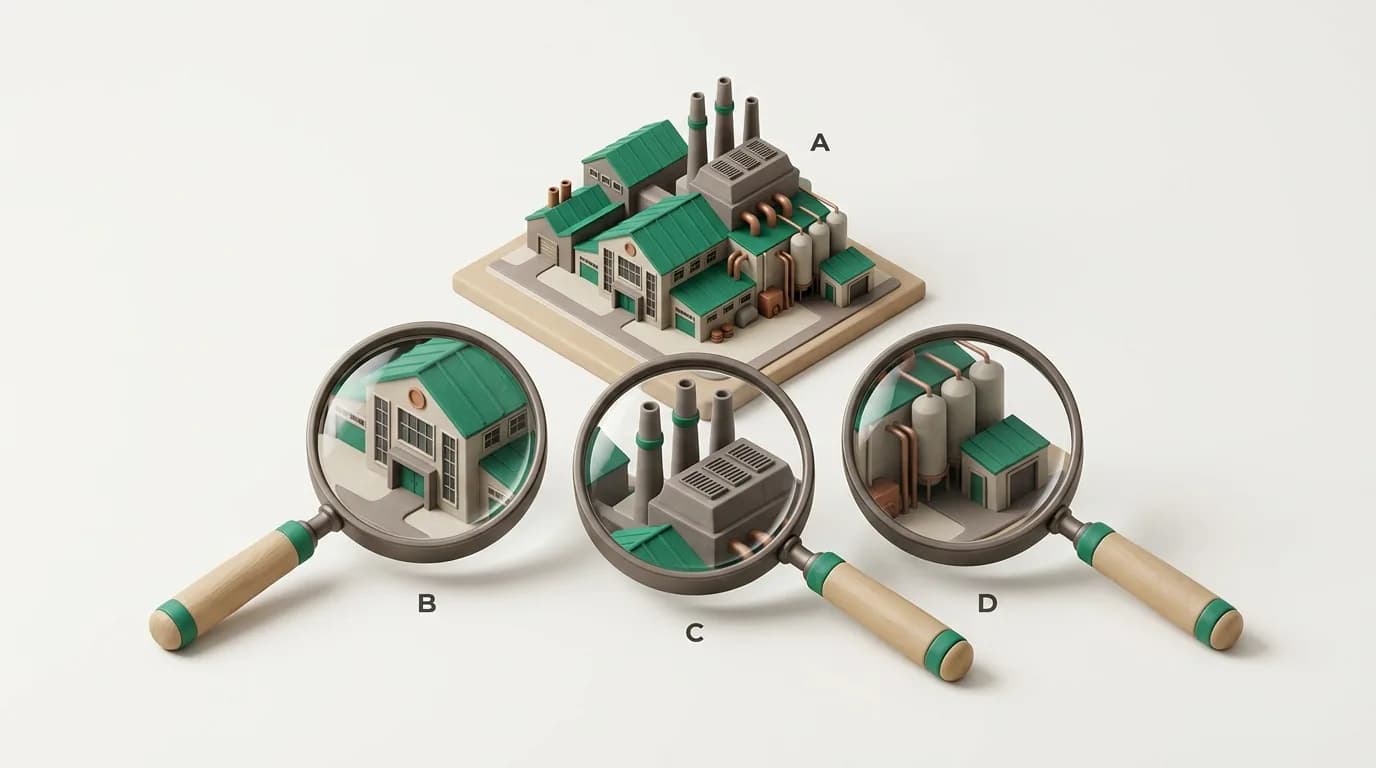
Techno-economic analysis (TEA), life cycle costing (LCC) and cost-benefit analysis (CBA) come out of the same toolbox but answer three different questions. TEA asks whether a technology or plant can stand economically at a given scale; LCC calculates the total cost of owning a product or building across its life cycle; CBA measures the net benefit of a decision to society. All three use discounted cash flows, all three define a time horizon and a system boundary; the difference lies in whose perspective, which indicator and which scope. Choosing the wrong method means a correctly calculated number answering the wrong question.
Three definitions, three questions
TEA comes from process engineering. It builds the mass and energy balance of a production technology (a new recycling line, an electrolyser, a biorefinery) and converts it into capital cost (CAPEX), operating cost (OPEX) and a revenue stream; its question is ‘will this plant make money at this scale and these prices?’. Its output is usually a feasibility decision and the uncertainty is high, because the technology typically does not exist yet.
LCC comes from building and product economics and is framed by ISO 15686-5 and EN 16627. Its question is ‘what does it cost to own this product or building over the analysis period?’; it sums acquisition, operation, maintenance, replacement and end-of-life costs and treats revenue only as a residual value in the manner of Module D, on a separate line. CBA comes from public economics: it monetises and compares the benefits and costs a policy or infrastructure decision creates for all parties, including health effects, time savings and environmental externalities. Its question is ‘does this decision leave society better off on balance?’.
Indicators: NPV and IRR, NPC and EAC, BCR

The indicator set gives away the method's question. TEA reports net present value (NPV) and internal rate of return (IRR); if NPV is above zero and IRR exceeds the cost of capital, the investment is considered economic. Payback period and levelised unit cost (for example the production cost per tonne of recycled material) are complementary indicators. LCC is cost-driven rather than revenue-driven, so it uses net present cost (NPC): the discounted sum of every cost within the analysis period. To compare alternatives with different lives, NPC is converted with the annuity factor into equivalent annual cost (EAC); the NPC of a 25-year roof and a 40-year roof cannot be compared directly, their EAC can. CBA's headline indicator is the benefit-cost ratio (BCR): discounted benefits divided by discounted costs, with a value above one saying the decision is socially defensible. The same discounting formula runs in all three places, but what goes into numerator and denominator is entirely different.
System boundary and time horizon
TEA's boundary is the plant: raw material enters at the gate, product leaves at the gate, everything in between is modelled and the product's later life is outside the calculation. The time horizon is the plant's economic life, typically 10 to 25 years. LCC's boundary is the life cycle of the product or building and aligns with the EN 15804 module structure (A1-A3 production, A4-A5 construction, B use, C end of life, D); the analysis period is usually the building's reference study period, 50 or 60 years for buildings. CBA's boundary is the widest of the three: everyone and everything affected by the decision, non-market effects included. That breadth makes CBA powerful but contested; the monetary value placed on a human life or on a tonne of CO₂ determines the result far more than the method itself does.
Perspective: investor, owner, society
Perspective determines the discount rate and what counts as a cost. TEA looks through the investor's eyes; the discount rate is the weighted average cost of capital and financial items such as tax, incentives and depreciation enter the calculation. LCC looks through the owner's or operator's eyes; the discount rate is the organisation's own opportunity cost and working in real terms is common, because over periods of decades the inflation forecast is the weakest link in the model. CBA looks through society's eyes; the discount rate is the social discount rate, lower than private-sector rates in most public guidance so that the benefit to future generations is eroded less. For the same roofing membrane the three methods use three different rates, and each is correct within its own frame.
Combining with LCA: ISO 14045 eco-efficiency
The three methods also relate to environmental LCA differently. When TEA and LCA are combined, technology comparison becomes two-dimensional: cost per tonne of product and kg CO₂e per tonne of product; this dual axis has become standard in early-stage technology assessment. Combining LCC with LCA is the most natural of the three, because EN 16627 and EN 15804 share the same module structure: every life cycle stage is written on the same row in both currency and CO₂e, and the eco-efficiency indicator defined by ISO 14045 (product system value per unit of environmental impact) can be computed directly. The practical output of this combination is the carbon abatement cost: the NPC difference between two alternatives divided by their CO₂e difference, in €/t CO₂e. CBA uses LCA as an input instead: LCA's physical impacts (kg CO₂e, kg PM2.5) are monetised with externality prices and added to the benefit-cost balance.
Which method for which decision
The choice depends on who the decision-maker is and on the scale of the decision. Whether to invest in a new production line or a recycling plant calls for TEA; which material, product or design to choose calls for LCC; the justification of a public policy or infrastructure project calls for CBA. For a manufacturer the second case is by far the most common: two products serving the same function, and a cost table that can sit next to the environmental table in the EPD.
- Feasibility of a new plant or technology → TEA (NPV, IRR, payback period, levelised unit cost)
- Choosing between product, material or design alternatives → LCC (NPC, EAC, cost per unit)
- Cost-optimal energy performance at building level → LCC with the EN 15459-1 global cost indicator
- Public policy, infrastructure, regulatory impact analysis → CBA (BCR, net present social benefit)
- Optimising cost and carbon together → LCC + LCA, ISO 14045 eco-efficiency and €/t CO₂e abatement cost
- Bringing environmental externalities into the decision in money terms → CBA, using LCA results as input
Frequently asked questions
- Are TEA and LCC the same thing?
- No. TEA asks whether a technology or plant will make money at a given scale and produces revenue-driven indicators such as NPV and IRR. LCC calculates the total cost of owning a product or building over its life cycle and produces cost-driven indicators such as NPC and EAC. In the construction sector the term ‘techno-economic analysis’ often refers in practice to module-mapped LCC.
- What is the difference between NPV and NPC?
- Both are sums of discounted cash flows. NPV takes revenues and costs together; if positive, the investment creates value. NPC sums costs only and is a positive number; the smaller alternative is preferred. In LCC revenue is exceptional and is reported separately as residual value or Module D revenue, never netted into the total.
- Why is cost-benefit analysis not used instead of LCC?
- CBA monetises non-market items such as health and environmental effects; for a product-level decision that is both unnecessary and contested. The price placed on a tonne of CO₂ determines the result more than the method does. For product and building decisions LCC keeps cost and LCA keeps environmental impact each in its own physical unit; the two are read side by side, neither is converted into the other.
- Do the three methods use the same discount rate?
- No. TEA uses the cost of capital (WACC), LCC the owner's opportunity cost, CBA the social discount rate. The social rate is usually the lowest. In LCC the use of a real rate with real cash flows is common; discounting real flows at a nominal rate is one of the most frequent errors.
- How is eco-efficiency calculated?
- ISO 14045 defines eco-efficiency as the ratio of product system value to environmental impact; the value side comes from LCC (or from functional value), the impact side from LCA. In practice the most used derived indicator is carbon abatement cost: the NPC difference between two alternatives divided by their CO₂e difference, in €/t CO₂e. A negative value shows the lower-carbon option is also the cheaper one.
Tags
- techno-economic analysis
- life cycle costing
- cost-benefit analysis
- NPC
- ISO 15686-5
- eco-efficiency
- ISO 14045
Related reading
All articles in Fundamentals- Data & Methods
How to calculate LCC: life cycle costing step by step
Life cycle costing (LCC) in seven steps: analysis period and functional unit, assigning items to EN 15804 modules, the real-versus-nominal decision, discounting and NPC, EAC, a worked example and sensitivity.
11 min read - Platform
What is techno-economic analysis? Combining LCC with environmental LCA in one model
Life cycle costing (LCC) is the economic twin of environmental LCA. The ISO 15686-5 and EN 16627 framework, NPC/EAC indicators, and why costs never enter the EPD.
12 min read - Standards
ISO 15686-5 and EN 16627: a guide to the LCC standards
The two standards of life cycle costing: the general methodology of ISO 15686-5, the EN 15804 module symmetry of EN 16627, cost categories, the reference study period, discounting and reporting rules.
9 min read - Fundamentals
What is greenwashing? Seven common forms
Most greenwashing is not deliberate falsehood but unsubstantiated good intent. Which claims carry risk, and how to make them defensible.
9 min read