ISO 15686-5 and EN 16627: a guide to the LCC standards
The two standards of life cycle costing: the general methodology of ISO 15686-5, the EN 15804 module symmetry of EN 16627, cost categories, the reference study period, discounting and reporting rules.
By clca Editorial TeamLast updated

Life cycle costing (LCC) is framed by two standards: ISO 15686-5 defines the general methodology of LCC for buildings and constructed assets; EN 16627 gives the calculation method for economic performance at building level within Europe's CEN/TC 350 sustainability family and inherits the module structure of EN 15804. The first answers "how are costs aggregated, discounted and reported"; the second answers "which cost goes into which life cycle box". They are complements rather than alternatives: a European building LCC applies the module structure of EN 16627 within the calculation discipline of ISO 15686-5.
The role of each standard: general methodology and the European building framework
ISO 15686 is the service life planning series; its fifth part is dedicated to life cycle costing. The standard defines the purpose and scope of LCC, cost categories, the analysis period, discounting logic, uncertainty and risk assessment and the content of the report; but it does not tie costs to a specific life cycle module structure. That flexibility lets the standard be used for every constructed asset, from buildings to infrastructure to plant equipment.
EN 16627 is the economic leg of CEN/TC 350's four-part structure: EN 15978 governs the environmental performance of buildings, EN 15804 the environmental declaration of construction products, EN 16309 social performance and EN 16627 economic performance. As a member of the same family, EN 16627 uses the building life cycle stages of EN 15978 (A, B, C, D) one-to-one and additionally defines a pre-construction stage A0 for costs such as land, permits and design fees. The result is that the environmental and economic assessments can be carried out on the same building model, with the same stage boundaries.
LCC or WLC? The cost categories
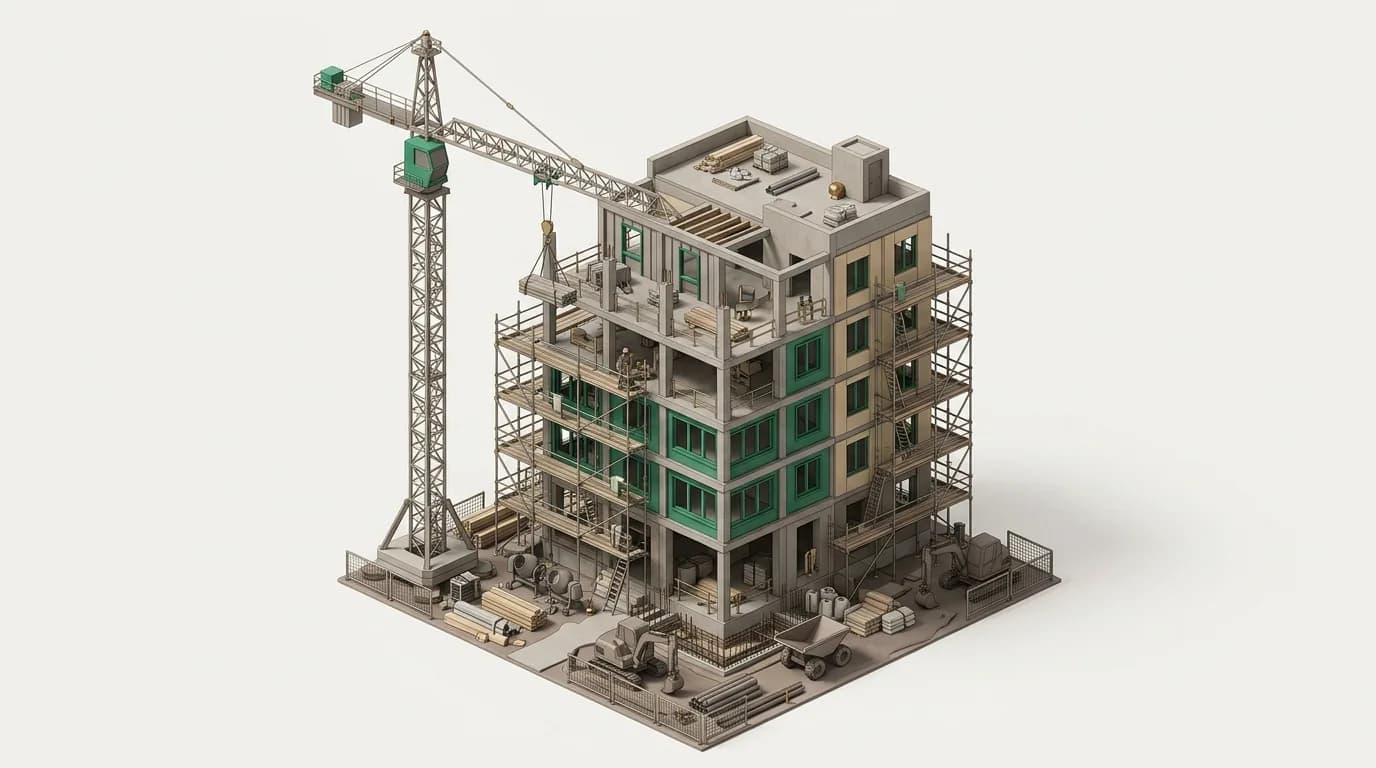
The most important distinction in ISO 15686-5 is between life cycle cost (LCC) and whole life cost (WLC). LCC covers the costs belonging to the asset itself; WLC adds non-construction costs, income and externalities on top. If a tender file says "LCC" but WLC was actually calculated, the alternatives can no longer be compared; that is why the report states explicitly which categories are included.
- Construction costs — design, materials, labour, site and commissioning
- Operation costs — energy, water, cleaning, insurance, taxes and management
- Maintenance costs — planned maintenance, repair, replacement and refurbishment
- End-of-life costs — deconstruction, waste transport, processing, disposal and site remediation
- Added for WLC — non-construction costs (land, finance), income (rent, sales, recovery value) and externalities (societal costs such as a carbon price)
Reference study period and discounting rules
Both standards fix the analysis period (RSP — reference study period) at the very start of the calculation and require it to be the same for all alternatives. In EN 16627 the building RSP usually matches the design life; typical values are 50 or 60 years. Residual value is mandatory for components that outlive the period and a replacement schedule for those that do not; otherwise a difference in life shows up as a difference in cost. On discounting, ISO 15686-5 permits both the real and the nominal approach but requires that they are not mixed; the source of the discount rate, the price date and the currency are stated in the report. The standard also asks for the sensitivity of the result to the discount rate and service life to be shown; a single NPC value cannot be reported without the rate it was calculated with.
The EN 15804 module symmetry
The practical value of EN 16627 is its module symmetry. The product stage (A1-A3), construction process (A4-A5), use (B1-B7), end of life (C1-C4) and benefits beyond the system boundary (D) are the same boxes in both the environmental and the economic assessment. The purchase price of an insulation board goes to A1-A3, its installation labour to A5, its replacement in year 30 to B4 and its removal to C1; the same board's kg CO₂e values sit in the same boxes. This symmetry lets the cost and carbon tables be read side by side, row by row, and lets composite indicators such as marginal abatement cost (€/t CO₂e) be derived. The rule for Module D is symmetrical too: the secondary-market value of recovered material is reported separately and not netted into the total cost — just as environmental Module D is not added to the A-C total.
Reporting requirements
ISO 15686-5 lists the minimum content an LCC report must carry: purpose and scope, the alternatives assessed, the analysis period, the cost categories included and excluded, currency and price date, the real/nominal choice and the discount rate, VAT and tax assumptions, the sources of service life data, data sources and quality, uncertainty and sensitivity analysis, results and limitations. EN 16627 adds a results table by module: the cost of each stage is shown on its own row, with the total and Module D given separately. The list is not bureaucracy; it is the minimum condition for a third party reading the report to reproduce the calculation. A cost without a price date, an NPC without a stated discount rate or a comparison with an unknown VAT mode cannot be verified.
The link to EN 15459-1
A third standard is often confused with these two: EN 15459-1 defines the global cost procedure for the economic evaluation of energy systems in buildings and underpins the cost-optimal calculation of European building energy performance regulation. Where EN 16627 covers the whole building and all cost categories, EN 15459-1 focuses on energy-related systems and energy costs; both use logic consistent with ISO 15686-5 for discounting and residual value. For a comparison of insulation thicknesses or heating systems the EN 15459-1 global cost is the right frame; for a comparison of building designs it is the module-based LCC of EN 16627; a well-built model produces both from the same cash flows.
Which standard for which situation?
- A construction product or element, cost side by side with the EPD — EN 16627 module structure + ISO 15686-5 calculation rules
- Building design alternatives, green building certification LCC credit — EN 16627
- Infrastructure, plant equipment, non-building assets — ISO 15686-5 (module structure optional)
- Cost-optimum for an energy system or insulation thickness — EN 15459-1 global cost
- Life cycle cost criterion in public procurement — ISO 15686-5 report content, with the category set defined by the tender specification
Frequently asked questions
- What is the core difference between ISO 15686-5 and EN 16627?
- ISO 15686-5 defines the general methodology of LCC for every kind of constructed asset (cost categories, analysis period, discounting, reporting) but imposes no particular module structure. EN 16627 is the economic leg of Europe's building sustainability family and inherits the EN 15804/EN 15978 module structure (A0, A1-A5, B1-B7, C1-C4, D). In practice they are used together.
- Are LCC and WLC the same thing?
- No. Under ISO 15686-5, LCC covers the asset's construction, operation, maintenance and end-of-life costs. Whole life cost (WLC) adds non-construction costs (land, finance), income and externalities. The report must state which was calculated and which categories were included; otherwise the alternatives cannot be compared.
- Which reference study period does EN 16627 recommend?
- EN 16627 does not impose a fixed number; it requires the RSP to be chosen in line with the building's design life and kept the same for all alternatives. In practice 50 or 60 years is common. Residual value is mandatory for components that outlive the period and a replacement schedule for those that fall short of it.
- Do the LCC standards allow costs to be written into an EPD?
- No. EN 16627 defines the economic assessment as a separate set of results, and ISO 14025 requires Type III environmental declarations to contain environmental information only. LCC results fed by the same model are published in a separate report; the EPD document carries no price or cost information.
- When is EN 15459-1 used?
- For the economic evaluation of energy systems and energy-efficiency measures in buildings. Its global cost indicator underpins the cost-optimal calculation of European building energy performance regulation. When the whole building design and all cost categories are assessed, EN 16627 is the basis; the two standards share the same discounting logic.
Tags
- ISO 15686-5
- EN 16627
- life cycle costing
- LCC standards
- whole life cost
- reference study period
- EN 15804
Related reading
All articles in Standards- Data & Methods
How to calculate LCC: life cycle costing step by step
Life cycle costing (LCC) in seven steps: analysis period and functional unit, assigning items to EN 15804 modules, the real-versus-nominal decision, discounting and NPC, EAC, a worked example and sensitivity.
11 min read - Standards
What is EN 15804+A2? A practical guide for product manufacturers
EN 15804+A2 (2019) is the mandatory European EPD standard for construction products. This guide covers indicators, the modulary table, MNR/MND, verification and end-to-end production with clca.
14 min read - Green Building
Building LCC and EN 15459-1 global cost: the cost-optimal calculation
The cost-optimal framework of European building energy regulation, the EN 15459-1 global cost formula, the financial and macroeconomic perspectives, the 30/20-year calculation period, an insulation thickness scenario and the Turkish context.
10 min read - Platform
What is techno-economic analysis? Combining LCC with environmental LCA in one model
Life cycle costing (LCC) is the economic twin of environmental LCA. The ISO 15686-5 and EN 16627 framework, NPC/EAC indicators, and why costs never enter the EPD.
12 min read