GWP-100 vs GWP-20: how the time horizon shapes your LCA result
IPCC's 100-year and 20-year global warming potential factors yield different results. Methane can shift by 4×. Why and when does that matter?
By clca Editorial TeamLast updated
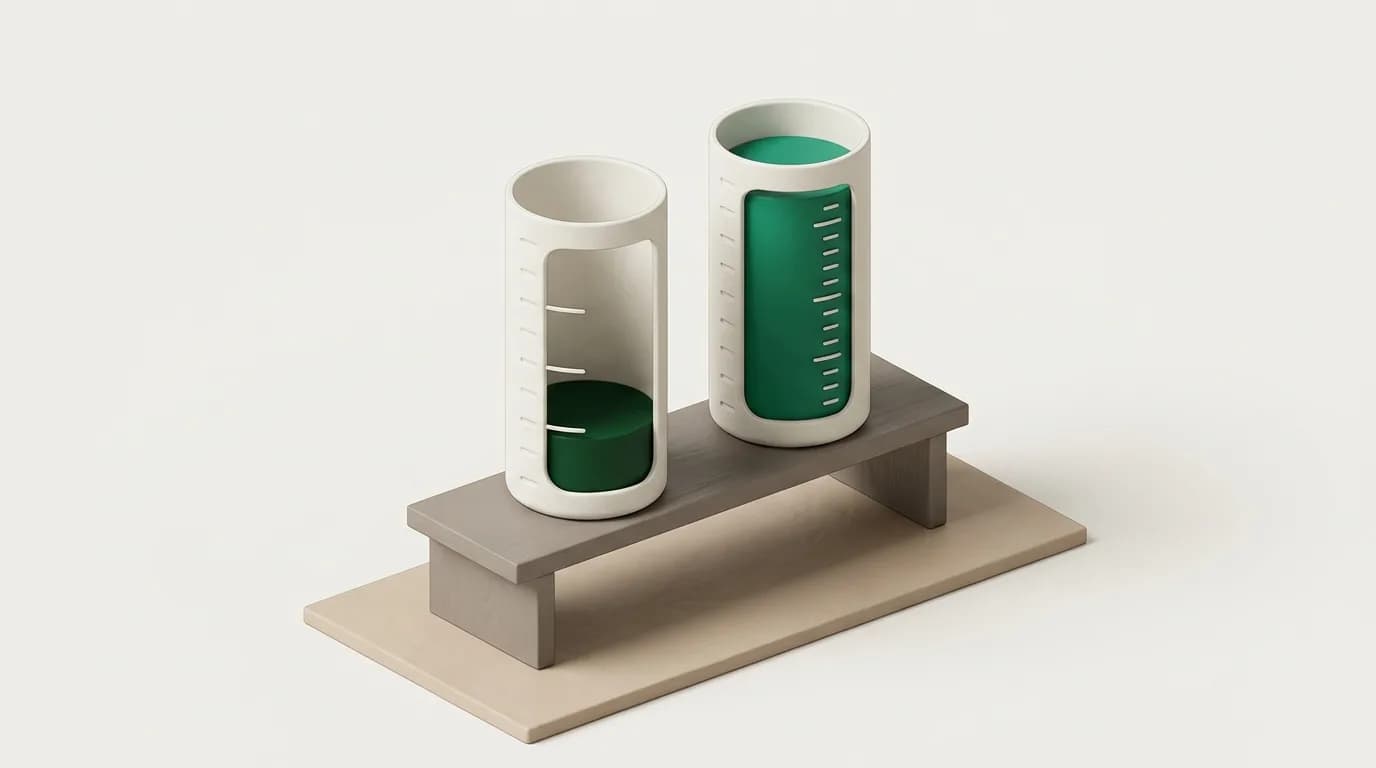
GWP (Global Warming Potential) looks like a single number but is actually a time-horizon-dependent metric. The two main horizons offered by the IPCC — 100 years (GWP-100) and 20 years (GWP-20) — value the same emission very differently. The choice is not academic — results can shift 30-200%.
Why a time horizon?
Greenhouse gases reside in the atmosphere for different durations. CO₂ is long-lived — hundreds of years. Methane (CH₄) lasts ~12 years. Over a 100-year horizon, methane's warming effect is averaged with long-lived CO₂ in a way that flattens the spike. Over a 20-year horizon, methane has not yet decomposed, so its contribution looks much larger. AR6 (IPCC 6th Assessment Report, 2021): methane's GWP-100 is 27.9, GWP-20 is 81.2 — almost 3× difference.
How much does it matter in construction LCA?
Construction materials are largely CO₂-dominant — fossil-fuel combustion and clinker process emissions in cement, steel, concrete are almost entirely CO₂. In these cases GWP-100 and GWP-20 yield similar results (5-10% difference). But for products involving biogenic waste streams (wood, bio-based plastics) methane emissions can matter — methane from organic landfill decomposition, leaks from composting. For these categories GWP-20 can be 30-50% higher.
Which standard uses which?
- EN 15804+A2 — GWP-100 (IPCC AR5 2013 values default; transition to AR6 under discussion)
- PEFCR + EF v3.1 — GWP-100 (IPCC AR5)
- GHG Protocol — GWP-100 (transition to IPCC AR6 in 2024-2025)
- IPCC reports — both GWP-100 and GWP-20 presented in parallel
- Some researchers — GWP* (new metric for short-lived gas pools)
AR5 vs AR6 — version differences
IPCC characterisation factors are revised with each assessment report. Between AR5 (2013) and AR6 (2021) methane's GWP-100 changed from 28 to 27.9 (close); but with climate-carbon feedback included the biogenic-methane version becomes 30. N₂O moved from 265 to 273. CFCs and HFCs received significant updates. EN 15804+A2 still references AR5 while EF v3.1 is shifting toward AR6 — meaning the same LCA model can produce 3-7% different GWPs across standards.
Tags
- GWP-100
- GWP-20
- methane GWP
- IPCC AR6
- climate change time horizon
Related reading
All articles in Data & Methods- Data & Methods
Recovery of organic waste: compost, biogas and open dumping
Organic waste substitutes no product; the credit comes entirely from avoided methane. Open dumping, landfill, composting and biogas compared on ecoinvent 3.12 data.
12 min read - Data & Methods
LCA hotspot analysis: finding the biggest impact by contribution
Hotspot analysis shows which process, flow or module the total environmental impact comes from. The three axes of contribution analysis, the Pareto logic, hotspots that shift by impact category, and the move to a reduction scenario.
10 min read - Data & Methods
Recovery credits by material: from PET to aluminium
A tonne of recovered aluminium and a tonne of paper do not earn the same credit. The primary and secondary route, the order of magnitude of the credit and the specific trap for each of six materials.
12 min read - Data & Methods
Beyond GWP: why the other impact categories matter
Focusing on carbon can reverse some decisions. The real role of acidification, eutrophication, ozone, toxicity and resource depletion.
11 min read