Steel LCA: BF-BOF vs EAF route comparison and scrap rate
GWP differs 2-3× between blast-furnace-basic-oxygen and electric-arc-furnace routes. Scrap rate, grid mix and the Module D recycle credit.
By clca Editorial TeamLast updated
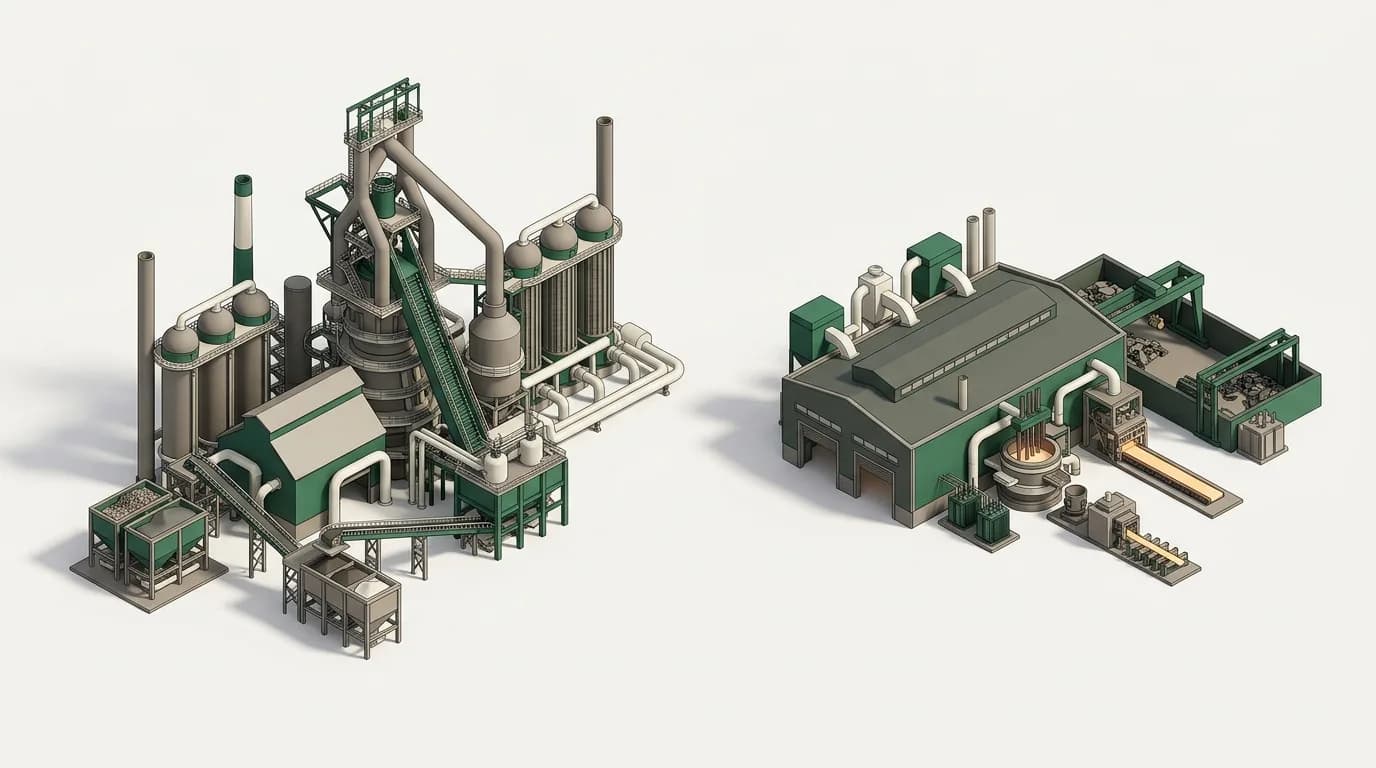
Steel has two main production routes: blast furnace + basic oxygen furnace (BF-BOF) and electric arc furnace (EAF). They produce the same finished product (e.g. IPE structural steel) but their environmental profiles differ dramatically. BF-BOF reduces iron ore with coke/coal — a CO₂-heavy chemical process. EAF melts scrap directly — bound to electricity. GWP differs 2-3×.
BF-BOF route — primary steel
BF-BOF is "primary" production starting from iron ore. Coke reduces iron oxide (Fe₂O₃ + 3CO → 2Fe + 3CO₂); then in the BOF, oxygen blown through removes carbon to yield steel. Typical GWP: 1.8-2.3 t CO₂eq/t of hot-rolled steel. Fuel-intensive — efficiency gains move 5-15%, but the chemical-emission floor is rigid. Scrap input is 10-30% feasible, but not much higher — the heat balance breaks.
EAF route — secondary steel

EAF melts steel scrap with electricity. Scrap + limited DRI (Direct Reduced Iron) + alloying inputs yield high-quality steel. Typical GWP: 0.5-0.8 t CO₂eq/t (drops as low as 0.3 with renewable-heavy grids). The whole GWP rides on grid mix and scrap quality. EAF steel on a Scandinavian grid has 4× lower GWP than BF-BOF steel on the EU average. Turkey reached ~45% renewable share in 2025; TR EAF is becoming competitive.
Scrap rate
Even EAF is not 100% scrap; typically 75-90% scrap + 10-25% DRI or pig iron. Scrap quality (alloyed vs carbon steel, contaminated vs clean) shapes finished-product quality. High-tonnage structural steel often uses lower-grade scrap, while automotive-grade hot-rolled needs careful selection. The EN 15804+A2 EPD must report the scrap rate transparently — it underpins the Module D credit.
Module D — the decisive credit for steel
Steel has one of the highest recycle rates of any material — 85-95% for structural steel. Almost all steel is re-melted after end-of-life; Module D reports this circular gain. The worldsteel methodology calculates the credit via the "value of scrap" approach — substituting future virgin-iron-ore use. A BF-BOF producer's Module D credit is -30% to -50%; an EAF producer is already not primary, so Module D is smaller because they already used scrap. This does not mean "both routes converge to the same net" — EAF retains its head-start advantage.
Practical EPD decision matrix
- Structural steel EPD — BF-BOF route shows higher A1-A3 net; but Module D improves cradle-to-cradle
- EAF route is competitive — especially on renewable-heavy grids
- For hot-rolled steel, worldsteel LCI methodology is preferred
- At 85%+ scrap rate, EAF beats BF-BOF in every scenario
- TR EAF for 2025+ (45%+ renewable grid) is gaining ground fast
Tags
- steel LCA
- BF-BOF EAF
- steel EPD
- steel scrap rate
- worldsteel methodology
- steel recycle credit
Related reading
All articles in Sectors- Sectors
Aggregate EPDs: quarry, crushing-screening energy and transport
Aggregate is one of the lowest-carbon construction materials per tonne, yet its volume makes it visible in a building's balance. An aggregate EPD is prepared with a 1 tonne declared unit; diesel, electricity and transport distance set the result.
11 min read - Sectors
Insulation EPDs: EN 16783 for glass wool, stone wool and EPS
An insulation EPD follows the EN 16783 PCR: the declared unit is the quantity of 1 m² of product that provides 1 m²K/W of thermal resistance. Hotspots of glass wool, stone wool and EPS, the A1–A3 order of magnitude and verifier pitfalls.
11 min read - Sectors
Preparing a concrete EPD: EN 16757 PCR and mix design data
A concrete EPD is prepared under EN 15804+A2 with the complementary PCR EN 16757: a 1 m³ declared unit, a mix per strength class, the cement EPD as an input, B1 carbonation and C/D scenarios.
10 min read - Sectors
Electronics LCA: chip fabrication, critical raw materials and the use stage
In electronics, impact concentrates in the component with the highest impact per gram. Semiconductor fabrication, critical raw material scarcity and the value of extending life.
11 min read