Concrete LCA: mix design, strength class and carbonation
Cement makes up 75-90% of concrete GWP. Mix-design optimisation, strength-class choice, B1 carbonation credit and EN 16757 PCR.
By clca Editorial TeamLast updated
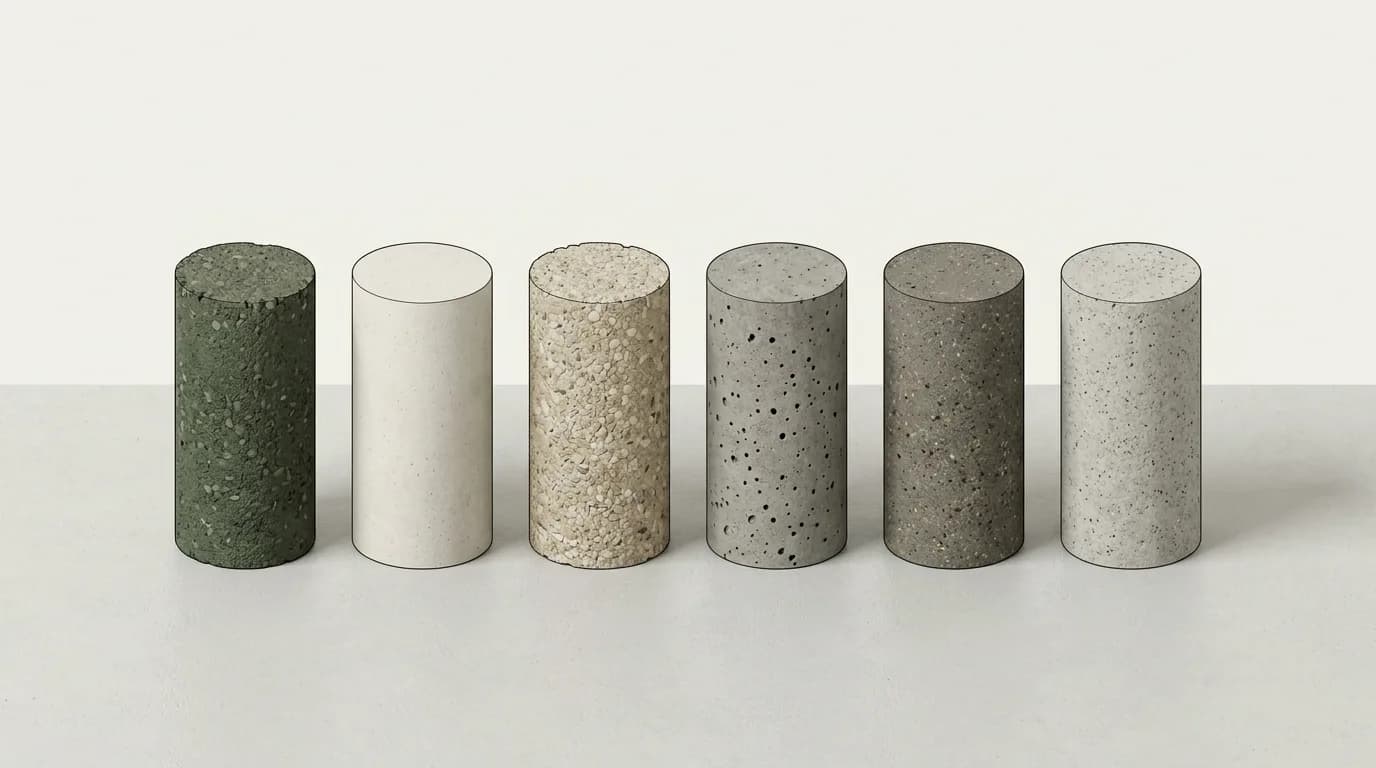
Concrete is the world's most consumed building material — 14 billion m³ produced annually. Alone it carries cement's carbon profile, plus aggregates, water, admixtures and batching-plant energy. The outcome of a concrete LCA model is directly tied to mix design.
EN 16757 functional unit
EN 16757 defines the concrete functional unit as "1 m³ of concrete at a specified strength class, under specified use conditions". Strength classes C25/30 (residential), C30/37 (general structural), C35/45 (heavy load), C40/50 (prestressed) drive cement quantity. Higher strength = more cement = higher GWP. Concrete comparisons without strength class are misleading.
Mix design parameters

- Cement content — kg/m³. C25/30 needs 280-340 kg, C40/50 needs 380-450 kg
- w/c ratio (water/cement) — 0.40-0.65. Lower ratio means more durable but requires more cement
- Aggregate type — crushed stone, gravel, recycled aggregate (CDW); local sourcing halves A4 emissions
- Superplasticisers (admixtures) — 1-2 kg/m³, small but meaningful GWP contribution
- Air-entrainers, accelerators, retarders — per condition
B1 — carbonation
Over a long service life, concrete slowly re-absorbs atmospheric CO₂ — the reverse of calcination. This is "carbonation". Over a 50-year service life, concrete can re-uptake 15-25% of its calcination-CO₂. EN 16757 accepts reporting this as an optional credit in module B1. Excessive carbonation accelerates rebar corrosion and creates structural issues; modelling balances carbonation depth against structural acceptability.
Low-carbon concrete strategies
A concrete producer's main GWP-reduction levers: (1) higher-SCM CEM (CEM III/IV/V) — 20-40% improvement; (2) optimised low-clinker mixes (slag + fly ash combo) — extra 15-25%; (3) CCUS-cement when available — extra 30-50%; (4) recycled aggregates (CDW) — 10-20% on aggregate share; (5) local aggregate sourcing (lower A4) — 5-10%. Stacked together, a C30/37 concrete falls from 320 to 180 kg CO₂eq/m³.
Ready-mix (RMC) vs precast
For ready-mix concrete (RMC), A4 is critical — concrete must be poured within 90 minutes, so average distance is 30-50 km. Precast concrete elements are factory-cured and shipped; A4 distances reach 200-500 km, but more efficient production and waste reduction in the plant yield A1-A3 savings. Precast typically shows 5-15% lower GWP than RMC, but distant construction sites can erase the advantage via A4.
Tags
- concrete LCA
- concrete EPD
- mix design LCA
- C25/30 GWP
- carbonation B1
- EN 16757
Related reading
All articles in Sectors- Sectors
Preparing a concrete EPD: EN 16757 PCR and mix design data
A concrete EPD is prepared under EN 15804+A2 with the complementary PCR EN 16757: a 1 m³ declared unit, a mix per strength class, the cement EPD as an input, B1 carbonation and C/D scenarios.
10 min read - Sectors
Aggregate EPDs: quarry, crushing-screening energy and transport
Aggregate is one of the lowest-carbon construction materials per tonne, yet its volume makes it visible in a building's balance. An aggregate EPD is prepared with a 1 tonne declared unit; diesel, electricity and transport distance set the result.
11 min read - Sectors
Cement LCA: clinker ratio, supplementary materials and carbon capture
Clinker accounts for 85-95% of cement GWP. CEM types, SCM (fly ash, slag, limestone) effect, and CCUS scenarios.
11 min read - Sectors
Insulation EPDs: EN 16783 for glass wool, stone wool and EPS
An insulation EPD follows the EN 16783 PCR: the declared unit is the quantity of 1 m² of product that provides 1 m²K/W of thermal resistance. Hotspots of glass wool, stone wool and EPS, the A1–A3 order of magnitude and verifier pitfalls.
11 min read