What is techno-economic analysis? Combining LCC with environmental LCA in one model
Life cycle costing (LCC) is the economic twin of environmental LCA. The ISO 15686-5 and EN 16627 framework, NPC/EAC indicators, and why costs never enter the EPD.
By clca Editorial TeamLast updated
If you have modelled a product's environmental profile with EN 15804+A2, you can model the economic profile of the same life cycle too. This is called techno-economic analysis (TEA), or more precisely life cycle costing (LCC). The logic is identical: flows arising at every stage from production to end of life are aggregated; the difference is that the flow is in currency rather than kg CO₂eq. A well-built LCC gives a numerical answer to "which design option is both cheaper and lower-carbon?".
ISO 15686-5 and EN 16627 — the standards framework for LCC
LCC is not an arbitrary cost table; it is framed by two standards. ISO 15686-5 defines the general methodology of life cycle costing for buildings and constructed assets: cost categories, the analysis period (RSP — reference study period), discounting logic and reporting. EN 16627 is the economic leg of the CEN/TC 350 sustainability family — it does for economic performance at building level what EN 15804 does for environmental assessment, and it inherits the module structure (A1-A3, A4-A5, B1-B7, C1-C4, D) one-to-one. This shared module structure is critical: the same life cycle stage lands in the same box on both the environmental and the economic axis.
Why costs never enter the EPD — the ISO 14025 boundary
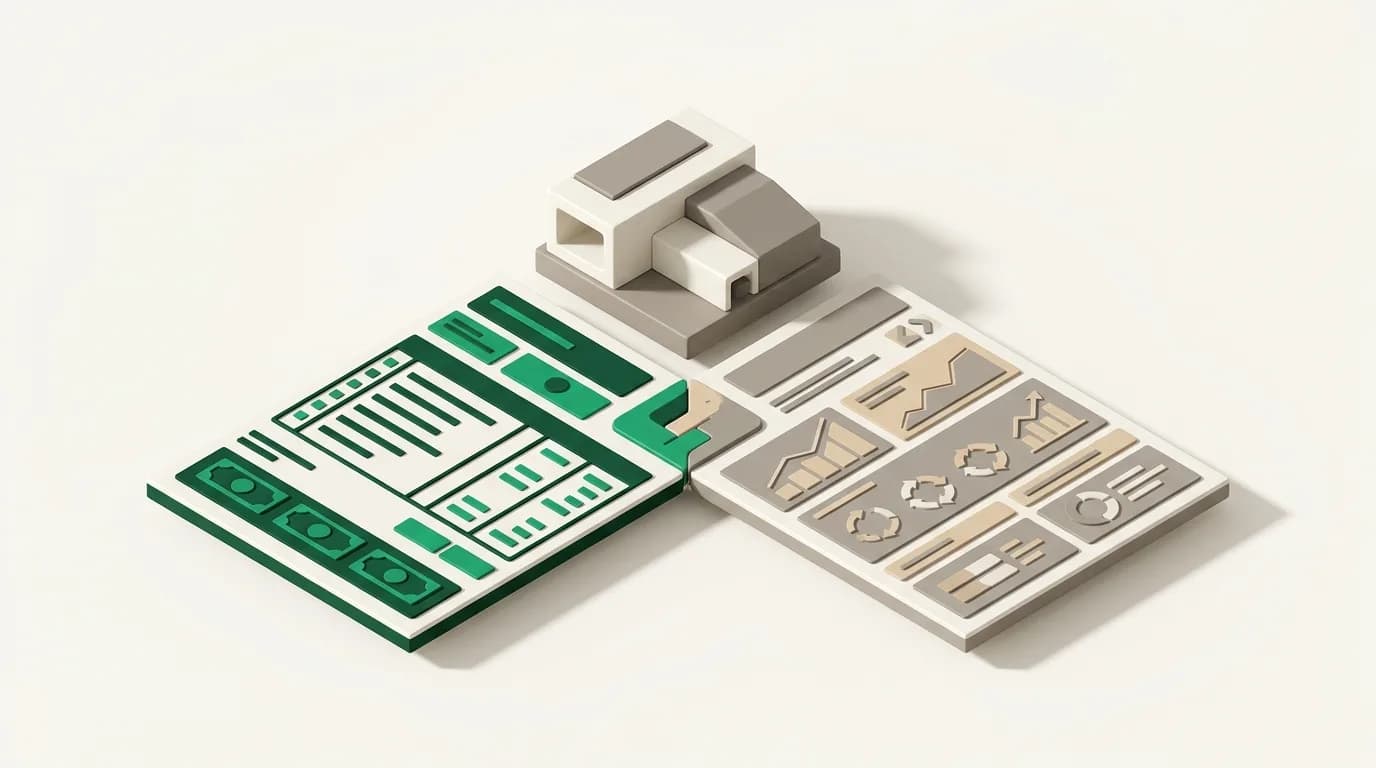
ISO 14025 requires Type III environmental declarations (EPDs) to carry environmental information only. Price, cost or profitability data cannot enter an EPD document; if it does, the verifier rejects the declaration. This is not a gap but a design decision: the EPD carries comparable, neutral environmental data, while price is negotiable and changes over time. The correct architecture is to build LCC as a separate report fed by the same model. clca does exactly this: cost items live in the same project as the LCA inventory, but not a single cost line leaks into the EPD PDF.
Module-mapped costing
In clca's LCC module every cost item is assigned to an EN 15804 module: raw material purchase to A1-A3, transport to site to A4, installation labour to A5, annual maintenance to B2, replacements to B4, operational energy to B6, deconstruction to C1, disposal to C4. Module D — the secondary-market value of recovered material — is reported separately and never netted into totals; this is the economic mirror of EN 15804's environmental module D rule. The result: the environmental table and the cost table read side by side, row by row.
NPC and EAC — the formula logic
The headline indicator of LCC is net present cost (NPC): every cost in the analysis period is discounted from the end of the year in which it occurs and summed. clca works in real terms — cash flows are stripped of inflation and the discount rate is entered as a real rate, removing inflation forecasting from the model. Equivalent annual cost (EAC) converts NPC into a constant annual payment via the annuity factor: it is the standard way to compare alternatives with different lives, because the NPC of a 25-year roof and a 40-year roof cannot be compared directly, but their EAC can.
- NPC — total discounted cost over the analysis period (end-of-year discounting)
- EAC — NPC annualised via the annuity factor; compares different service lives
- Cost per functional/declared unit — same denominator as the EPD
- EN 15459-1 global cost — indicator aligned with building energy-performance regulation
- Module D — separate line; never netted into total NPC
Replacement schedule and residual value
If the analysis period (T) exceeds the component's service life (SL), replacements are computed automatically: N = ceil(T/SL) − 1. For a 20-year component over a 50-year analysis period, ceil(50/20) − 1 = 2 replacements are scheduled (in years 20 and 40). If service life remains at the end of the period, the remaining life converts to a residual value by linear depreciation and is discounted as an end-of-period credit. Without these two mechanisms, long-lived products are systematically penalised.
Related reading
All articles in Platform- Standards
ISO 15686-5 and EN 16627: a guide to the LCC standards
The two standards of life cycle costing: the general methodology of ISO 15686-5, the EN 15804 module symmetry of EN 16627, cost categories, the reference study period, discounting and reporting rules.
9 min read - Data & Methods
How to calculate LCC: life cycle costing step by step
Life cycle costing (LCC) in seven steps: analysis period and functional unit, assigning items to EN 15804 modules, the real-versus-nominal decision, discounting and NPC, EAC, a worked example and sensitivity.
11 min read - Platform
How to choose LCC software: 7 criteria for LCA-integrated costing
What decides a life cycle costing tool is not the feature list but whether costs share the environmental LCA's module structure, how transparent the discounting is, and the audit trail.
11 min read - Fundamentals
TEA, LCC and cost-benefit analysis: how the three methods differ
Techno-economic analysis asks whether a technology will pay, LCC asks what an asset costs to own, and cost-benefit analysis asks about net benefit to society. The same cash flows, three different questions.
10 min read