Insulation product LCA: U-value, lambda, RC and the functional unit
Insulation LCA must tie the functional unit to thermal performance. The relationship between λ, RC, U-value and the B6 benefit debate.
By clca Editorial TeamLast updated
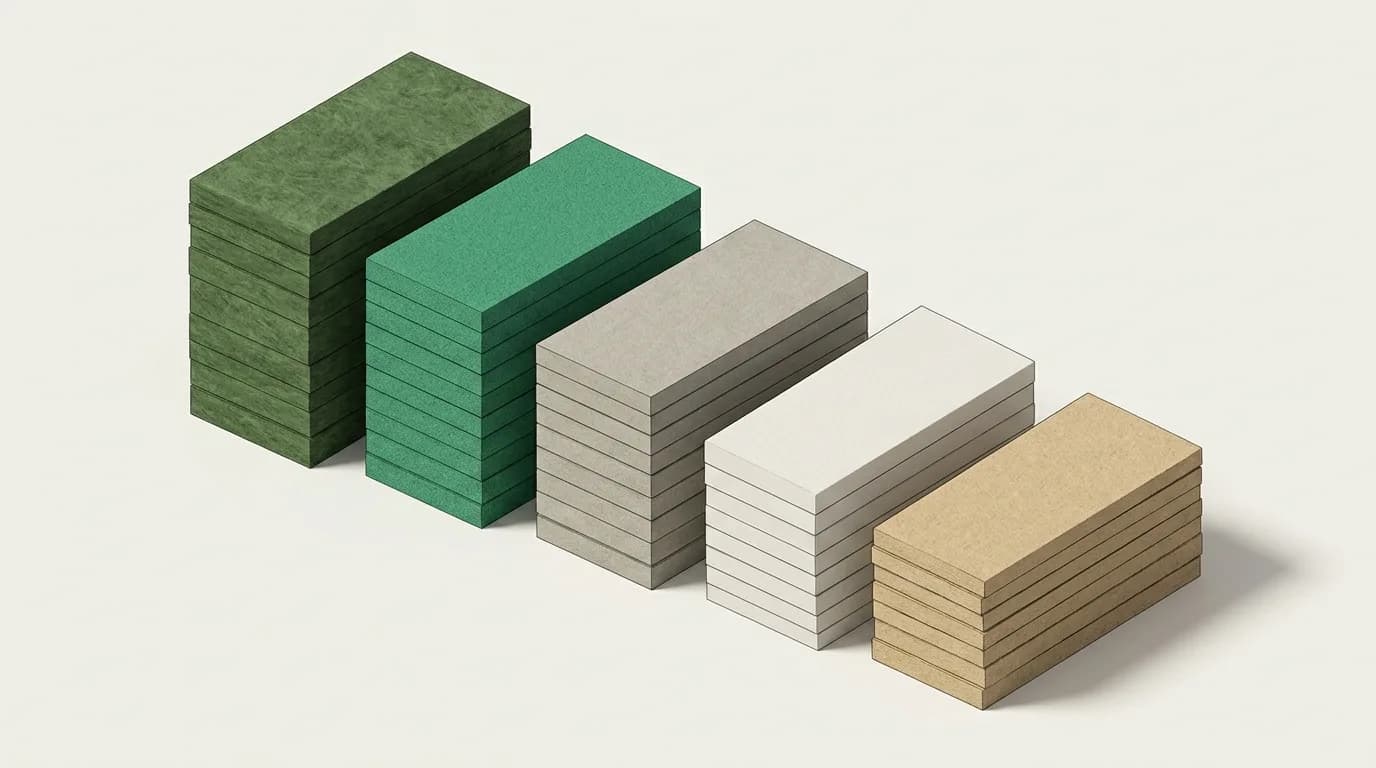
The most common mistake in insulation LCA is comparing materials by mass. Glass wool, stone wool, EPS, XPS, PIR/PUR, wood fibre — these six main categories have different densities and different thermal performance; "1 kg" comparison is unfair. EN 16783 PCR therefore ties the functional unit to thermal performance.
λ, RC, U — three critical parameters
- λ (lambda) — thermal conductivity, W/m·K. How well it insulates; low λ = good. Glass wool ~0.034, EPS ~0.036, PIR ~0.024
- RC (thermal resistance), m²K/W. RC = thickness (m) ÷ λ. 100 mm glass wool = 0.1 / 0.034 = 2.94 m²K/W
- U (thermal transmittance), W/m²K. U = 1 / total RC. Low U = low loss. Passive house target U ≤ 0.15 W/m²K
EN 16783 functional unit choice

EN 16783 offers two options: (a) "1 m² of product providing 1 m²K/W of RC" (RC-based), or (b) declared unit as "1 m² of product at a specified thickness". The RC-based choice is fair — it automatically balances products with different λ values. Comparing PIR (λ=0.024) with glass wool (λ=0.034): for the same RC, PIR needs less mass, so A1-A3 emissions are lower. Glass and stone wool lack low-λ advantage and carry mass disadvantage; they recover via ECO-Platform CDM scoring (fire safety, recyclability).
B6 — use-phase energy savings
The most contested module in insulation LCA is B6. Insulation's very purpose is to save energy; you may want B6 to report this as a positive environmental benefit. EN 16783 makes this optional but conditional: specific climate zone (European Cold/Temperate/Warm), building type, energy-mix assumptions must all be documented. A product's real B6 benefit over 50-year service life can be -10 to -50× the embodied emissions; the A1-A3 burden is repaid hundreds of times. A powerful marketing message — but it must be documented.
A5 — installation waste
A5 waste rates by insulation type: board products (glass wool, stone wool, EPS, XPS) 3-8% (cutting waste, geometry mismatch); spray foams (PIR/PUR) 1-2% (overspray); ETICS systems 5-10% (corner, joint, cutting). EN 16783 mandates a 3% minimum; verifiers reject anything below it. If the installer has on-site waste measurement, use it; otherwise back-calculate from annual supply-vs-sales delta.
C and D — end-of-life category split
End-of-life varies dramatically by category. Glass and stone wool can be cullet-recycled — actual recycle rate 20-40%, with frequent down-cycling; modest Module D credit. EPS sees energy recovery (incineration) 50-70%; absent renewable energy the Module D carbon credit is small, but in a co-gen plant it counts as fossil-fuel substitution. PIR/PUR and wood fibre lean to energy recovery; PIR has the paradoxical advantage of long-term landfill carbon storage (CO₂ stays out of the atmosphere).
Tags
- insulation LCA
- insulation EPD
- EN 16783
- R-value functional unit
- glass wool EPS comparison
Related reading
All articles in Sectors- Sectors
Insulation EPDs: EN 16783 for glass wool, stone wool and EPS
An insulation EPD follows the EN 16783 PCR: the declared unit is the quantity of 1 m² of product that provides 1 m²K/W of thermal resistance. Hotspots of glass wool, stone wool and EPS, the A1–A3 order of magnitude and verifier pitfalls.
11 min read - Sectors
Aggregate EPDs: quarry, crushing-screening energy and transport
Aggregate is one of the lowest-carbon construction materials per tonne, yet its volume makes it visible in a building's balance. An aggregate EPD is prepared with a 1 tonne declared unit; diesel, electricity and transport distance set the result.
11 min read - Sectors
Preparing a concrete EPD: EN 16757 PCR and mix design data
A concrete EPD is prepared under EN 15804+A2 with the complementary PCR EN 16757: a 1 m³ declared unit, a mix per strength class, the cement EPD as an input, B1 carbonation and C/D scenarios.
10 min read - Sectors
Electronics LCA: chip fabrication, critical raw materials and the use stage
In electronics, impact concentrates in the component with the highest impact per gram. Semiconductor fabrication, critical raw material scarcity and the value of extending life.
11 min read