From inventory to verified EPD: the end-to-end LCA workflow in clca
The five phases of an EPD project from declared-unit definition to the verifier package: inventory, calculation, QA, report and lock.
By clca Editorial TeamLast updated
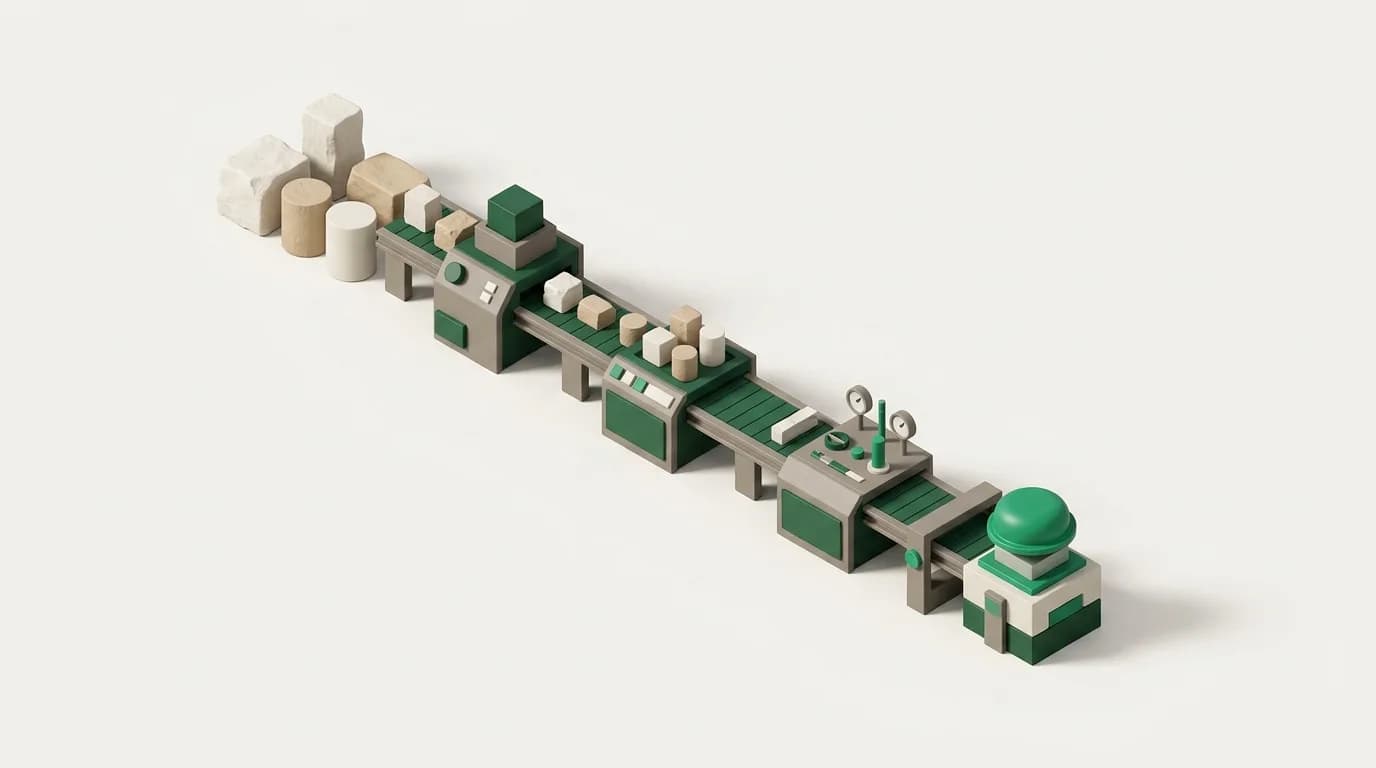
An EPD project passes through five phases on its way to the verifier package: scope and declared unit, inventory, calculation, quality assurance, report and lock. The order matters — most projects that fail in practice are those that rush to the report before the inventory is complete. This post walks the end-to-end flow in clca step by step, from a manufacturer's perspective.
1. Scope: declared unit and module selection
The project starts with the declared unit (e.g. 1 m³ of C30/37 concrete, 1 kg of steel profile) and the module selection. Under EN 15804+A2, A1-A3, C1-C4 and D are mandatory; A4-A5 and the B modules are added per PCR and product. In clca the module selection happens up front because result tables, transport calculations and end-of-life scenarios all hang off this skeleton.
2. Inventory: materials, energy, transport

In the inventory phase the product recipe is entered and each line is linked to an ecoinvent 3.12 activity. For electricity you pick a country mix — the TR grid mix if you manufacture in Turkey, or a custom mix if you hold a green tariff contract. Transport runs on the distance service: enter origin and destination and tonne-kilometres are computed automatically, split across road/sea/air/rail. If you do not know the supplier's truck class, the PCR's default vehicle class applies.
3. Calculation: methods and result tables
The calculation engine runs EF v3.1 (the characterisation set mandated by EN 15804+A2), CML v4.8 2016 and CED; results come back module by module in the EN 15804 table structure (Tables 8, 9, 11, 12, 13). Every indicator is reported across your selected module columns (A1-A3, A4, A5, ... C4, D). Calculation takes seconds; the real time goes into the inventory — which is the right proportion.
4. QA: catch it before the verifier does
Verifiers ask three questions most often: does the mass balance close, do the flows make sense, are the results within the sector band? clca's QA tools answer these before verification. The mass balance check compares input and output mass per module; the Sankey / mass-flow diagram visualises the largest flows; the process tree unfolds which background activity contributes what, layer by layer.
- Mass balance — input mass ≈ product + waste + emissions; warning above the deviation threshold
- Sankey diagram — flow-level visualisation of GWP contribution
- Process tree — contribution breakdown of background activities
- Sector band comparison — where the result sits versus comparable EPDs
5. Report and lock
The moment a report is generated, the inventory locks: the model behind the numbers heading to verification can no longer change freely; changes become limited and traceable. This prevents the mid-verification "why did the numbers change?" crisis. If the verifier requests revisions, the lock opens in a controlled way, changes are made, and a new version is reported.
The verifier package consists of the EPD PDF, the project report and the inventory export. A well-prepared package cuts verification rounds from several to one or two — and at 1-3 weeks per round, a day spent on QA buys back weeks of calendar.
Tags
- LCA software
- EPD preparation
- LCA workflow
- ecoinvent 3.12
- mass balance
- inventory lock
Related reading
All articles in Platform- Platform
How to choose LCA software: eight evaluation criteria
Comparing feature lists misleads. What actually decides it is database access, verifiability and fit with your workflow.
10 min read - Platform
Background data selection with ecoinvent 3.12: activity, geography and electricity mix
The three decisions in background data selection — right activity, right geography, right electricity mix — can move the result more than the inventory itself.
10 min read - Platform
CAPEX/OPEX and EN 15804 modules: the two axes of cost + €/t CO2e marginal abatement cost
Every cost item is classified on two axes: EN 15804 module and cost nature. This dual axis underpins marginal abatement cost (€/t CO2e) and the cost-carbon quadrant plot.
11 min read - Platform
Multi-client LCA management for consultants: workspaces, portfolio and bring-your-own-database
Ten clients, forty projects, three verification timelines: the operational side of LCA consulting and how multi-tenant architecture answers it.
10 min read